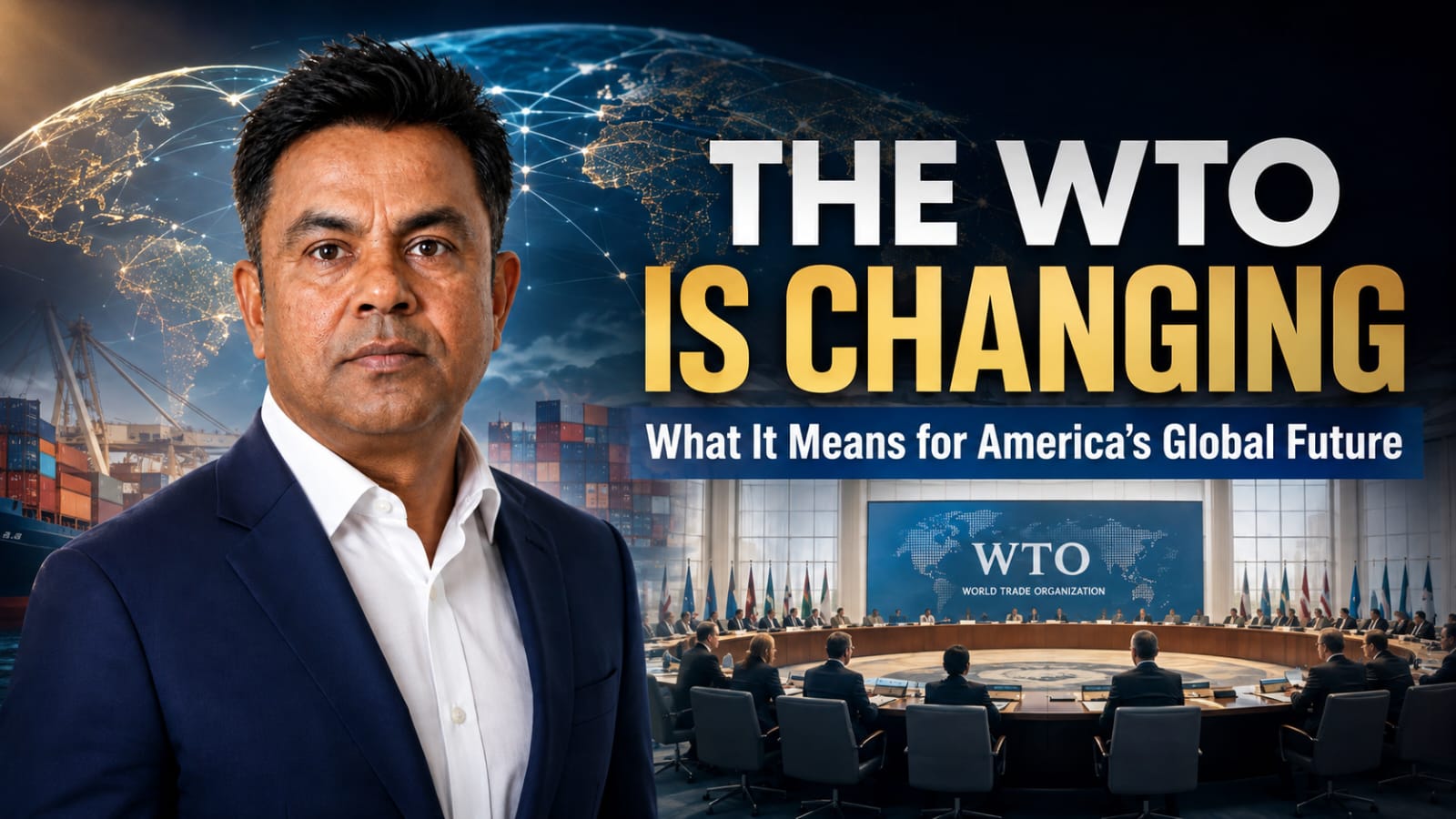
WTO Reform After MC14: What It Means for America and the Future of Global Trade
By Ashok Aacharya
Spiritual Wellness Strategist | Strategic Forecaster & Global Trends Analyst | Vedic Astrology Researcher | Author & Speaker | Advisor to Global Leaders Since 1990
Ancient Wisdom. Modern Strategy. Better Decisions
The most important WTO story in 2026 is not the ministerial conference that already happened.
It is what happens next.
The World Trade Organization’s 14th Ministerial Conference, or MC14, took place in Yaoundé, Cameroon, from March 26–30, 2026. The meeting produced several outcomes, but major questions about the future of the trading system remain under discussion. WTO members are continuing work on institutional reform, negotiations and other unresolved issues. In July, WTO Director-General Ngozi Okonjo-Iweala called for simultaneous progress on WTO reform and outstanding negotiations.
For the United States, this deserves attention.
Not because the WTO is simply another international institution, but because the future of global trade increasingly intersects with issues that matter directly to America’s economic strength: technology, manufacturing, supply chains, national security, digital commerce, competition and global influence.
My question is therefore not simply, “What will happen to the WTO?”
It is:
What does the post-MC14 transition mean for America’s economic and strategic position in the world?
That is the question I believe deserves closer examination.
The WTO Is Entering a Different Phase
The WTO was created to provide a rules-based framework for international trade and to make global commerce more predictable.
But the world in which that framework operates has changed.
Trade is no longer discussed only in terms of tariffs, market access and exports.
Today, governments are also thinking about semiconductor supply chains, critical minerals, artificial intelligence, data, energy security, strategic manufacturing and dependence on foreign suppliers.
Economic policy and national security are increasingly connected.
That does not mean globalization is ending.
I see something more complicated happening.
Globalization is becoming more strategic.
Countries still need international trade. Businesses still need international markets. Consumers still depend on global supply chains.
But governments are becoming more selective about where dependence is acceptable, which industries are strategically important and which economic relationships should be strengthened.
That is the environment in which WTO reform is taking place.
Why This Matters to America
For the United States, the WTO question is ultimately a question about influence.
America remains one of the world’s most important economic, technological and financial powers. But the global economic environment is becoming more competitive and more fragmented.
The United States Trade Representative’s Office continues to handle U.S. policy coordination and negotiations involving the WTO, and U.S. statements and participation in WTO bodies have continued throughout 2026.
That tells us something important.
Washington is still paying attention to the institution.
But attention does not necessarily mean that the United States will accept the WTO exactly as it has operated in the past.
The more relevant American question is:
Can the WTO be made more effective for the realities of today’s global economy?
That question reaches into dispute settlement, negotiations, transparency, market access and the ability of the institution to respond to new forms of competition.
For American policymakers, this is not an abstract institutional debate.
It is connected to America’s ability to protect its interests while maintaining influence over the rules of international commerce.
America’s Next Trade Challenge Is Bigger Than Tariffs
Tariffs receive much of the public attention because they are visible and immediate.
But the deeper strategic questions are broader.
Who controls critical supply chains?
Who leads in artificial intelligence?
Who produces advanced technologies?
Who controls access to critical minerals?
Who writes the rules for digital commerce?
Where will American companies manufacture?
How much economic dependence is strategically acceptable?
And how should the United States balance open markets with national economic security?
These questions are likely to become increasingly important.
For American business leaders, this means that international trade strategy can no longer be separated completely from geopolitical strategy.
A supply chain decision can become a strategic decision.
A technology decision can become a national-security decision.
A regulatory decision can affect international competitiveness.
This is why I believe the WTO debate deserves to be viewed through a much wider lens.
The Digital Economy Changes the Conversation
One of the clearest signs of change is digital trade.
Global commerce increasingly includes software, cloud services, digital platforms, data, artificial intelligence and other electronically delivered services.
The WTO’s long-standing e-commerce work entered a new phase after members failed to extend the previous moratorium on customs duties on electronic transmissions at MC14. The moratorium lapsed on March 30, 2026, while discussions on the future of digital trade continue.
This is a significant development.
The future of trade will not be determined only by what crosses a physical border.
Increasingly, value will also move through digital networks.
That creates a new strategic arena for the United States.
America has enormous strengths in technology, innovation, software, finance and digital services.
The rules governing digital commerce therefore matter directly to American economic interests.
The question is no longer simply:
Who exports the most goods?
It is increasingly:
Who helps define the rules of the digital economy?
That question will become even more important as artificial intelligence becomes embedded in business and international commerce.
AI Could Make WTO Reform More Important
Artificial intelligence is beginning to change the economics of trade itself.
AI can affect productivity, services, logistics, research, manufacturing, financial markets and the way businesses operate across borders.
It also creates new questions around regulation, data, intellectual property and access to technology.
The WTO is now bringing trade and technology into more direct discussion. Its 2026 World Trade and Tech Day is focused on the relationship between trade and technology, including artificial intelligence, while the WTO Public Forum in September is addressing broader questions about the future of trade.
For the United States, this is strategically important.
America has an opportunity to remain a major rule-shaper in the emerging digital economy.
But leadership in technology does not automatically guarantee leadership in international rule-making.
That will require sustained engagement.
What Should American Businesses Watch?
I would encourage American business leaders to watch five areas closely.
1. WTO Reform
The details of institutional reform may appear technical, but they can affect the effectiveness of the international trading system.
2. Digital Trade
Businesses operating in software, AI, cloud services, data and digital platforms should pay increasing attention to international trade rules.
3. Supply-Chain Resilience
The cheapest supply chain is not always the safest supply chain.
Strategic resilience is becoming part of corporate decision-making.
4. Geopolitical Alignment
Companies increasingly need to understand how relationships between major powers can affect investment, technology, sourcing and market access.
5. The Changing Definition of Globalization
The next generation of globalization may be less about unlimited integration and more about trusted networks, strategic partnerships and economic resilience.
These are not predictions about one particular event.
They are structural trends worth watching.
What Happens Next at the WTO?
The answer is still developing.
That is precisely why this is a subject worth watching now.
The WTO reform process continues after MC14, and members are working through questions about how the organization should function in a changing global economy. The WTO has described reform as an ongoing process rather than something completed at MC14.
The WTO’s Public Forum, scheduled for September 15–17, 2026, will provide another important opportunity for governments, businesses, civil society and other stakeholders to discuss the future of global trade.
So I would not describe 2026 as the year in which the WTO is either “finished” or “saved.”
I would describe it as a transition period.
And transition periods are often when long-term strategic choices become visible.
My Strategic Forecast
My assessment is that the global trading system is moving toward a more fragmented but still highly interconnected model.
I expect four broad developments to remain important through the coming years.
First, globalization will continue, but it will become more strategic.
Companies and governments will continue trading globally, but security, resilience and political alignment will influence economic decisions more than they did in earlier phases of globalization.
Second, technology will become a larger part of trade policy.
AI, digital services, data and intellectual property will increasingly sit alongside traditional trade issues.
Third, economic power and geopolitical power will become harder to separate.
The countries with strong technology, capital, manufacturing capability, resources and strategic partnerships will have greater influence over the global economic system.
Fourth, the United States will remain central to the outcome.
America’s challenge will not simply be protecting its position.
It will be deciding how to use its economic, technological and institutional strengths to help shape the next phase of global commerce.
That is where I see the most important strategic question.
A Vedic Perspective on Structural Change
My work also includes Vedic astrology research.
I want to make an important distinction here.
I do not present astrology as empirical proof of an economic or geopolitical outcome.
Facts, economic data, institutional developments and political decisions must be evaluated on their own evidence.
Vedic astrology offers a different lens.
I use it as a traditional framework for studying longer cycles, patterns of transition and periods in which established structures may undergo significant change.
From that perspective, major institutional transitions can be examined not simply as isolated events, but as part of broader cycles of change.
For me, the value is not in replacing conventional analysis.
It is in asking an additional question:
Can traditional knowledge offer another way of thinking about the timing and character of long-term change?
That is an interpretive question, not a claim of scientific certainty.
I believe responsible forecasting should be transparent about that distinction.
My Outlook for America
I do not believe the United States is moving toward a world in which global trade becomes irrelevant.
I believe America is moving into a world in which the strategic value of trade is changing.
The winning question may no longer be:
“How much can we trade?”
It may increasingly become:
“What should we trade, with whom, under what rules, and with what level of strategic dependence?”
That is a very different question.
For American businesses, it means strategy must increasingly incorporate geopolitics.
For policymakers, it means trade policy must increasingly consider technology and national security.
For investors, it means global economic trends deserve to be studied alongside geopolitical developments.
And for anyone trying to understand America’s position in the world, it means the future of trade deserves far more attention than the daily tariff headline.
The Bigger Question
The WTO reform debate is ultimately about more than the WTO.
It is about the future architecture of global economic cooperation.
Can multilateral institutions adapt?
Can countries cooperate while competing?
Can international trade remain open while governments pursue economic security?
Can new rules keep pace with AI and digital commerce?
And perhaps most importantly:
Will the next phase of globalization be designed primarily around efficiency, or around resilience and strategic trust?
I believe the answer will be a combination of both.
The world is unlikely to become completely deglobalized.
It is more likely to become selectively globalized.
That distinction could define the next decade.
Final Thought
The future of global trade should not be viewed through fear, political slogans or simplistic predictions.
It deserves careful observation.
Facts tell us where the world is.
Strategic analysis helps us understand where it may be going.
And traditional knowledge systems, including Vedic astrology, can provide an additional perspective on longer-term cycles and patterns.
My approach is to keep these perspectives distinct while allowing them to inform a broader understanding of the future.
For America, the next chapter of global trade will not be determined by the WTO alone.
It will be shaped by technology, geopolitics, business decisions, national strategy and the ability of institutions to adapt.
The question is not whether the global trading system is changing.
It is who will help shape what comes next.
Frequently Asked Questions
What is the WTO?
The World Trade Organization (WTO) is the international organization responsible for administering global trade rules and providing a forum where its members negotiate trade issues and resolve trade disputes.
What happened at WTO MC14?
WTO MC14 was held in Yaoundé, Cameroon, from March 26–30, 2026. Members reached several outcomes, while a number of important issues remained under discussion and moved into continuing work after the conference.
Is WTO reform still happening after MC14?
Yes. WTO reform remains an active process after MC14. Members are continuing discussions about how the organization should function and how it can respond more effectively to changes in the global trading system.
Why does WTO reform matter to America?
WTO rules can affect market access, trade policy, dispute settlement, digital commerce and the broader rules governing international trade. For the United States, the issue is also connected with competitiveness, technology, supply-chain resilience and global economic influence.
Why should U.S. businesses pay attention to WTO reform?
Businesses operating internationally can be affected by changes in trade rules, tariffs, market access, supply chains, digital commerce and regulatory conditions. Understanding the direction of global trade policy can therefore become part of long-term strategic planning.
How is AI changing global trade?
AI is changing productivity, services, logistics, manufacturing and digital commerce. It is also creating new questions around data, intellectual property, regulation and cross-border digital activity. These developments are likely to make technology an increasingly important part of future trade policy.
What does WTO reform mean for the future of globalization?
WTO reform is part of a larger transition in global commerce. Globalization is unlikely to simply disappear, but it may become more selective and strategically driven as countries place greater emphasis on resilience, technology, national security and trusted economic relationships.
What is Ashok Aacharya’s perspective on WTO reform?
My approach combines factual analysis of economic and geopolitical developments with strategic forecasting and, where appropriate, a clearly identified Vedic astrological perspective. I treat these as complementary lenses rather than presenting astrology as empirical evidence.
About the Author
Ashok Aacharya — Spiritual Wellness Strategist | Strategic Forecaster & Global Trends Analyst | Vedic Astrology Researcher | Author & Speaker | Advisor to Global Leaders Since 1990
Since 1990, Ashok Aacharya has advised business leaders, entrepreneurs, professionals, public figures, and HNIs internationally. His work combines strategic analysis, global trends, human behavior, and Vedic wisdom, with an emphasis on critical thinking and responsible interpretation. His insights have been featured in The Times of India, Business Standard, ANI, Zee News, Speaking Tree, Navbharat Times, Amar Ujala, News Nation, and other leading media.
Ancient Wisdom. Modern Strategy. Better Decisions.