CEO Decision Fatigue: Strategic Workspace Alignment
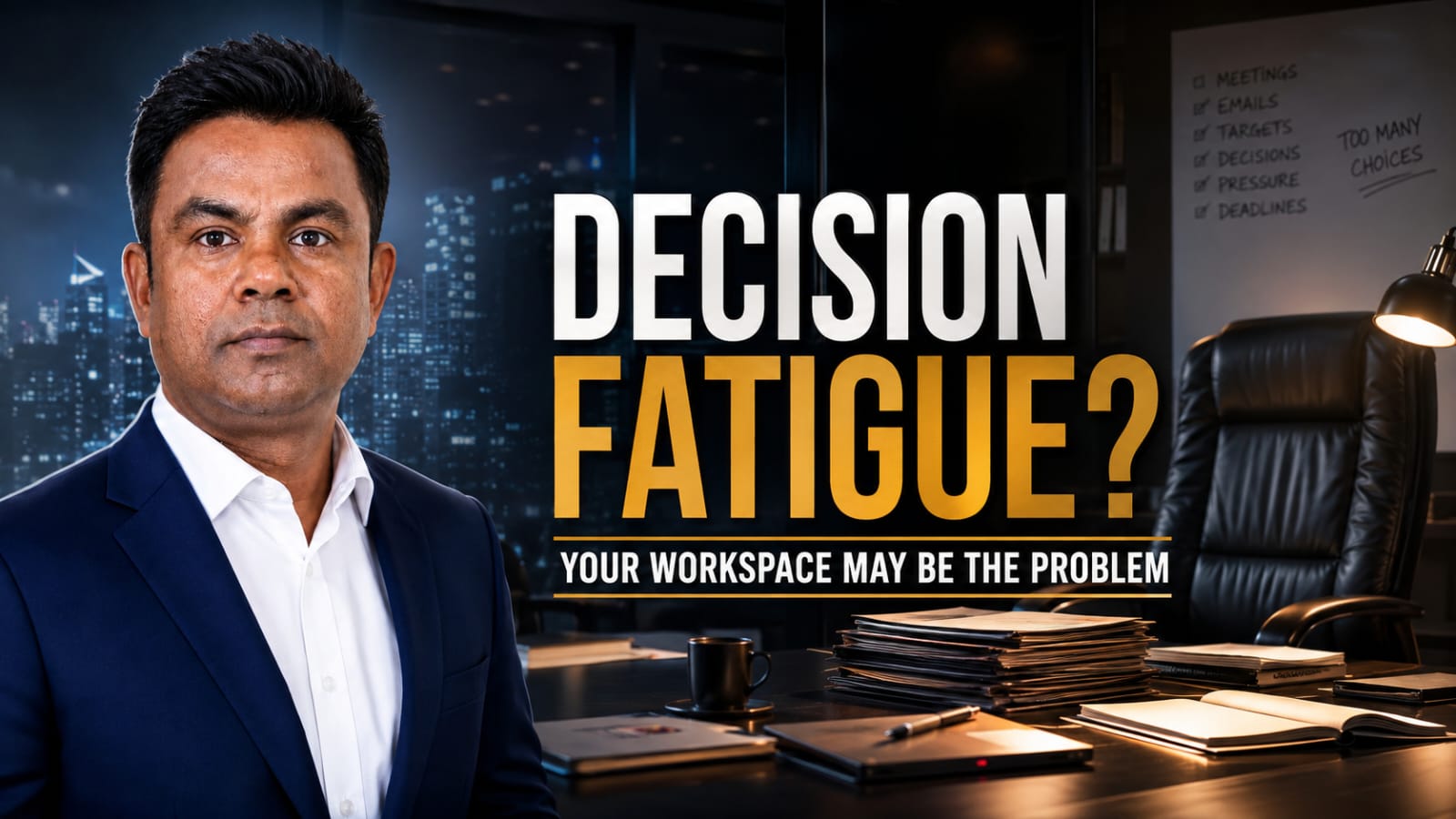
High-performing CEOs rarely struggle because they lack intelligence or information. More often, too many consequential decisions compete for the same limited attention, while the workspace itself may reinforce interruption, cognitive load, and reactive behavior.
In advisory practice since 1990, I have repeatedly observed an important distinction: executives often try to solve decision fatigue by improving the quality of decisions, when the more powerful move can be improving the conditions in which decisions are made.
Why CEOs Experience Decision Fatigue
CEO decision fatigue is the gradual erosion of decision quality, patience, attention, and prioritization when a leader must repeatedly evaluate competing demands. For a CEO, it can appear as delayed decisions, unnecessary escalation, constant context switching, over-analysis of low-value issues, or impulsive choices made simply to clear the queue.
The strategic issue is therefore not how to make more decisions. It is how to reserve high-quality cognitive capacity for decisions that genuinely require executive judgment.
A useful executive workspace should separate thinking from reacting. When every notification, visitor, meeting, document, and operational question arrives in the same physical and psychological space, attention can become fragmented.
Three workspace questions are particularly important:
- Where does deep strategic thinking happen?
- Where are routine operational conversations handled?
- What environmental cues signal interruption versus concentration?
The objective is not an expensive office redesign. It is a deliberate operating environment in which the physical setting supports the executive’s decision architecture.
Strategic Workspace Alignment: A Practical Framework
Strategic workspace alignment means designing the executive environment around the cognitive and behavioral requirements of leadership. It considers physical layout, interruptions, visual complexity, privacy, meeting patterns, and environmental cues before adding more productivity systems.
Vastu Shastra, the ancient Indian science of spatial energy alignment, can be considered here as a reflective framework rather than a deterministic system. Its traditional emphasis on orientation, placement, movement, openness, and functional zoning can be translated into a modern workplace question: does the environment support the behavior and mental state required for the work being performed?
For executive use, that means examining practical factors first: desk orientation, sightlines, circulation, lighting, noise, privacy, meeting-room placement, storage, visual clutter, and the location of high-frequency interruptions. Traditional Vastu principles may then provide an additional interpretive layer for evaluating spatial relationships.
A practical executive alignment process can follow five steps:
- Map decision categories: Separate strategic, financial, people, operational, and urgent decisions.
- Audit interruption patterns: Identify who, what, and where repeatedly breaks concentration.
- Create functional zones: Designate spaces for deep work, meetings, collaboration, and quick decisions.
- Reduce visual and digital noise: Keep the primary field of attention deliberately simple.
- Review the environment periodically: Workspace needs should evolve as leadership responsibilities change.
One overlooked issue is decision residue: the mental carryover from an unfinished conversation or unresolved choice into the next task.
An executive may leave a meeting physically, yet continue processing it while reviewing a forecast, interviewing a senior candidate, or considering an investment.
Workspace zoning can help create clearer transitions between decision modes. A short reset between meeting-heavy periods and deep work can be as important as the work itself.
The same principle applies to executive meetings. If every meeting occurs in the CEO’s primary thinking space, the room can gradually become associated with interruption rather than reflection. Separating meeting functions from strategic work, where practical, creates a stronger psychological boundary.
Business and Performance Impact
Better workspace alignment can support executive focus, clearer boundaries, and more intentional behavior by reducing avoidable environmental friction. The objective is not to claim that a particular direction, object, or arrangement produces a guaranteed business outcome.
Decision fatigue is often amplified by friction that appears trivial in isolation. A poorly positioned screen, constant foot traffic, excessive meeting density, or an overfilled desk may not determine a decision, but repeated exposure to such friction can make sustained concentration harder.
The business impact of better workspace alignment is therefore indirect but meaningful.
For founders and CEOs, there is also an organizational signal. The executive office communicates operating norms. A workspace dominated by interruptions can normalize interruption across the organization. A workspace that visibly protects strategic thinking can signal that focused work, preparation, and thoughtful decisions have institutional value.
This is where strategic forecasting becomes relevant. Forecasting is not only about anticipating external events; it is also about preparing the organization to respond to uncertainty.
A CEO who protects cognitive capacity is better positioned to evaluate scenarios, challenge assumptions, recognize changing signals, and decide when evidence is incomplete.
Numerology or timing frameworks may also be used by some leaders as reflective tools for structuring planning cycles or personal review periods. They should not be presented as substitutes for financial analysis, governance, market intelligence, or evidence-based decision-making. Their most responsible use is as a prompt for reflection, not as a mechanism for certainty.
The strongest executive workspace is ultimately not the most luxurious one. It is the one that makes the right behavior easier.
It protects concentration when concentration matters, supports dialogue when collaboration matters, and creates boundaries when the leader needs to step back from immediate demands.
For CEOs experiencing persistent decision fatigue, the first intervention does not have to be another productivity system. Start by examining the environment in which decisions are being made.
Ask what repeatedly consumes attention, what encourages unnecessary interruption, and whether the physical workspace reflects the strategic priorities of the role.
A well-aligned workspace cannot eliminate uncertainty. It can, however, help reduce avoidable friction and create better conditions for judgment.
For senior leaders, that distinction matters: strategic clarity is not produced by information alone; it is also shaped by the systems, spaces, and habits that determine how attention is used.
Practical Executive Takeaways
- Protect one clearly defined zone for uninterrupted strategic thinking.
- Separate high-consequence decisions from routine operational conversations.
- Audit physical and digital interruptions before adding another productivity tool.
- Use Vastu Shastra as a reflective spatial framework, not as a deterministic promise.
- Review workspace alignment when the CEO’s role, team structure, or decision load materially changes.
This article is a strategic and reflective lens and is not a substitute for professional financial, medical, or legal advice.
FAQ
What causes decision fatigue in CEOs?
CEO decision fatigue can develop when leaders repeatedly evaluate competing priorities, interruptions, people issues, operational demands, and strategic choices without sufficient cognitive recovery. The result may be reduced patience, delayed decisions, excessive analysis, or reactive choices. Managing decision load therefore requires attention not only to workflows but also to the environment in which decisions occur.
Can workspace design help reduce executive decision fatigue?
Workspace design can help reduce avoidable cognitive friction by separating strategic thinking, meetings, collaboration, and routine operational activity. Clear zones, fewer interruptions, better privacy, reduced visual clutter, and deliberate meeting boundaries can support sustained attention. Workspace design does not eliminate decision fatigue, but it can create conditions more supportive of executive clarity.
How can Vastu Shastra be applied to an executive workspace?
Vastu Shastra can be used as a reflective framework for examining spatial relationships, orientation, movement, openness, and functional placement in an executive environment. A responsible approach begins with practical workplace factors such as lighting, noise, privacy, circulation, and ergonomics, then considers traditional Vastu principles as an additional interpretive perspective.
What is strategic workspace alignment?
Strategic workspace alignment is the practice of organizing an executive environment around the cognitive and behavioral requirements of leadership. It considers where strategic thinking occurs, how interruptions are managed, how meetings are separated from deep work, and whether the physical environment supports the leader’s priorities. The goal is better conditions for judgment, not guaranteed outcomes.
About Ashok Aacharya
Ashok Aacharya is a Spiritual Wellness Strategist, Strategic Forecaster, Global Trends Analyst, Author, Speaker, and Vedic Astrology Researcher. Since 1990, he has advised corporate leaders, entrepreneurs, and high-net-worth individuals worldwide — integrating Vedic Astrology, Vastu Shastra, Spirituality and Numerology with business strategy and behavioral insight. Guided by the philosophy Ancient Wisdom. Modern Strategy. Better Decisions, his work favors critical thinking over superstition. Featured in The Times of India, Speaking Tree, Nav Bharat Times, NBT ASTRO, Business Standard, Zee News, News Nation, and Amar Ujala an more