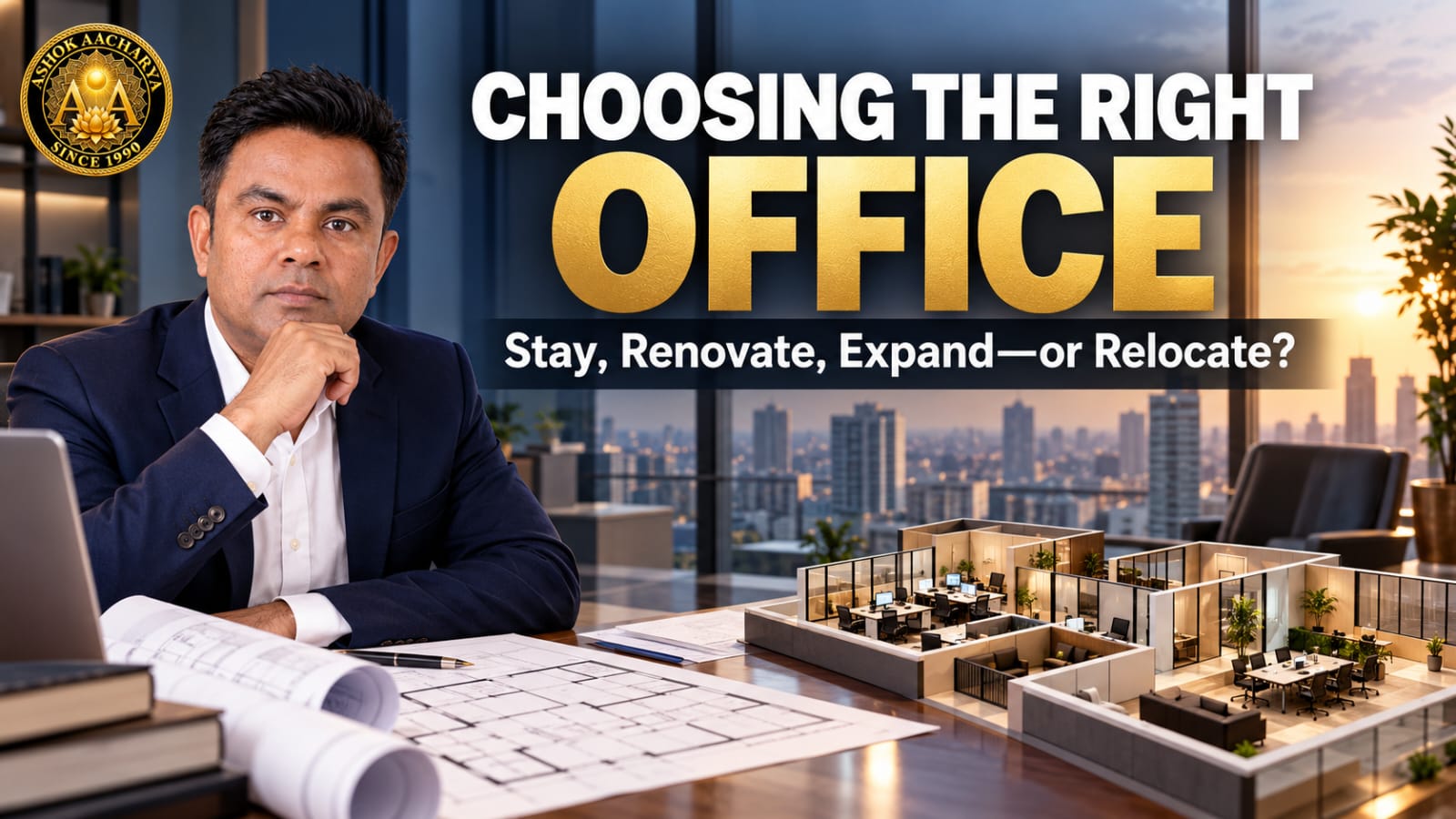
How to Choose the Right Office Space for Your Business
An office decision is rarely just a real-estate decision.
For a growing business, deciding whether to stay, renovate, expand, or relocate can affect operating costs, employee experience, collaboration, technology, client perception, and the ability to adapt to future growth.
The better question is not simply:
“Which office should we choose?”
It is:
“What physical environment does the business actually need for its next stage?”
Modern workplace research increasingly focuses on space utilization, collaboration, employee experience, technology readiness, and flexibility. This means choosing an office is becoming less about securing more square footage and more about creating a space that works for the organization.
1. First Decide: Stay, Renovate, Expand or Relocate?
Before searching for another property, identify the actual problem with your current workplace.
Ask:
- Is the existing space genuinely too small?
- Is the layout creating operational problems?
- Are meeting rooms inadequate?
- Are privacy or acoustic issues affecting work?
- Does the location create commuting or recruitment problems?
- Is the office outdated technologically?
- Has the business model changed?
- Is significant growth expected?
- Does the workplace represent the business appropriately to clients?
- Could renovation solve the problem more efficiently than relocation?
Then compare four options.
Stay
Keep the existing location if its fundamentals remain suitable and the problems can be addressed without major disruption.
Renovate
Improve the layout, technology, finishes, meeting areas, work zones, or functionality without changing location.
Expand
Add capacity when the existing location works strategically but additional space is required.
Relocate
Move when the current location, building, economics, or physical environment no longer supports the business.
The objective is not to move simply because a newer office looks attractive. The objective is to create a workplace that supports the business.
2. Start With the Business, Not the Floor Plan
There is no universally ideal office.
The right space depends on how the organization actually operates.
Before evaluating properties, define:
- How much individual work is required
- How much collaboration is required
- How frequently clients visit
- Which activities require privacy
- How leadership functions within the workplace
- Technology and infrastructure requirements
- Employee and visitor accessibility
- Expected business growth
- How the workplace may need to change over the next three to five years
A technology company, law firm, consulting business, financial-services organization, and creative company may require very different workplace environments even with similar headcounts.
The workplace should follow the business model—not the other way around.
3. Don’t Choose an Office by Rent or Square Footage Alone
Rent or purchase cost is important, but it is only one part of the decision.
Evaluate the actual usefulness of the space.
Consider:
- Usable versus inefficient space
- Circulation
- Meeting-room capacity
- Privacy
- Acoustics
- Natural light
- Technology infrastructure
- Storage
- Employee amenities
- Accessibility
- Layout flexibility
- Future reconfiguration requirements
A cheaper office can become expensive if it requires extensive modifications or fails to support the way the business operates.
Likewise, a larger office is not automatically a better office.
Evaluate space for business performance—not simply for size.
4. Evaluate Location as a Business Asset
Location is more than an address.
It can influence:
- Employee accessibility
- Recruitment
- Client convenience
- Public transportation
- Parking
- Business ecosystem
- Nearby services and amenities
- Brand perception
- Accessibility requirements
- Long-term business continuity
A prestigious address may have limited practical value if employees struggle to reach it or clients rarely want to visit.
Conversely, a less prominent location may work extremely well when it provides the right combination of accessibility, functionality, and cost.
Choose a location because it supports the business strategy—not simply because it looks impressive.
5. Calculate the Total Cost of the Office Decision
The financial comparison should go beyond rent.
Consider the full cost of occupancy:
- Rent or purchase cost
- Service charges
- Utilities
- Fit-out
- Furniture
- Technology
- Maintenance
- Security
- Moving costs
- Business disruption
- Lease obligations
- Professional fees
- Future modifications
Fit-out costs can also vary significantly by market, building quality, and specification.
The important point is that the headline property cost may represent only part of the actual financial commitment.
Calculate the cost of making the space work—not just the cost of acquiring the space.
6. Test the Office Against the Future
An office should not be evaluated only for today’s requirements.
Test it against at least three scenarios.
Scenario A: Stable Business
What happens if the organization remains approximately the same size?
Scenario B: Growth
What happens if headcount, clients, or operations increase significantly?
Scenario C: Business Transformation
What happens if technology, artificial intelligence, hybrid work, or changes in the operating model alter the way people use the office?
A space that works today but becomes inefficient after a relatively small change may create another expensive property decision sooner than expected.
Flexibility has economic value.
7. Then Consider the Vastu Perspective
Once the business, financial, location, and workplace fundamentals have been evaluated, Vastu can be considered as an additional spatial lens.
Vastu Shastra is a traditional Indian architectural and spatial-planning system concerned with concepts such as orientation, proportions, spatial organization, and the relationship between different areas of a built environment.
For a modern commercial property decision, it can be considered alongside—not instead of—business analysis, financial evaluation, architecture, engineering, legal due diligence, and workplace strategy.
The practical question is not:
“Does Vastu guarantee that this office will succeed?”
A more responsible question is:
“How does the spatial configuration compare with relevant Vastu principles, and how well does the space fit the actual requirements of the business?”
Vastu should therefore be understood as a traditional interpretive framework rather than a guarantee of financial or organizational outcomes.
8. Look at the Whole Space, Not Just One Direction
A common mistake is to reduce commercial Vastu to a single entrance direction.
A meaningful assessment should consider the property and its spatial organization more broadly.
Depending on the situation, this may include:
- Site and overall orientation
- Main entrance
- Internal circulation
- Functional zoning
- Leadership areas
- Employee work areas
- Meeting and collaboration spaces
- Private or confidential areas
- Support functions
- Proportions and spatial relationships
- Overall organization of the workplace
The purpose is to evaluate the space as a system rather than make a decision based on one isolated feature.
9. What Vastu Can—and Cannot—Do
Vastu Can Provide
- A traditional framework for spatial organization
- An additional perspective on orientation and zoning
- A culturally rooted approach to evaluating built environments
- Another lens for comparing potential properties
- A structured way to examine how different spaces are organized
Vastu Cannot Guarantee
- Business success
- Higher profits
- Increased revenue
- Wealth creation
- Employee performance
- Customer behavior
- Investment returns
- Commercial success
Business outcomes depend on many variables, including strategy, leadership, market conditions, execution, capital, people, location, and competition.
A responsible Vastu assessment should recognize those boundaries.
10. A 10-Point Office Decision Framework
Before committing to a new office, purchasing a property, or undertaking a major renovation, evaluate these ten areas:
- Business — Does the space support the operating model?
- People — Does it work for employees, leadership, and visitors?
- Location — Does the location support access, recruitment, and clients?
- Building — Is the building appropriate for the business?
- Cost — What is the complete cost of occupancy?
- Layout — Does the space support productive workflows?
- Technology — Can the workplace support current and future technology needs?
- Flexibility — Can the space adapt as requirements change?
- Future — Will it remain appropriate as the business evolves?
- Vastu — Does the spatial configuration align with relevant traditional Vastu principles, where this is important to the decision-maker?
This framework helps prevent one attractive feature—such as a prestigious address, low rent, or large floor plate—from dominating the entire decision.
11. A Simple Final Decision Test
Before signing a lease, purchasing a property, or committing to a major renovation, ask five questions:
1. Does this space solve the actual business problem?
2. Does the financial case make sense when the full cost is considered?
3. Does the workplace support the people and activities that matter most?
4. Can the space adapt to future business requirements?
5. If Vastu is relevant to the decision, what additional spatial insight does it provide?
If these questions cannot be answered clearly, the property decision may require further analysis before commitment.
The Right Office Is Not Necessarily the Biggest or the Cheapest
The right office is not automatically the largest, newest, cheapest, or most prestigious option.
It is the space that supports the business you are actually building.
A sound office decision combines:
- Business strategy
- Property fundamentals
- Financial discipline
- Workplace requirements
- Future flexibility
- Professional due diligence
- A responsible Vastu assessment, where relevant
Before asking:
“Is this office good according to Vastu?”
Ask the more fundamental question:
“Is this space right for the business—and what additional insight can Vastu contribute?”
That shift turns office selection from a simple property search into a more structured strategic decision.
Frequently Asked Questions
Should I stay, renovate, expand, or relocate my office?
Start by identifying the actual business problem. Compare the cost, operational impact, and future implications of staying, renovating, expanding, and relocating before deciding which option addresses the problem most effectively.
How do I choose the right office space for my business?
Evaluate business requirements, people, location, building quality, total occupancy cost, layout, technology, flexibility, future needs, and any additional criteria—such as Vastu—that are relevant to your decision.
Is Vastu important when choosing an office?
Vastu can be considered as an additional traditional spatial-planning perspective. It should be evaluated alongside business, financial, architectural, engineering, and legal considerations rather than treated as a substitute for them.
Can Vastu guarantee business success?
No. Vastu should not be presented as a guarantee of revenue, profit, wealth, employee performance, or business success.
Is the office entrance the most important Vastu factor?
A responsible assessment should not reduce an entire property to one direction or one feature. The overall site, orientation, spatial organization, zoning, and relationship between different areas should be considered in context.
Can modern workplace strategy and Vastu be considered together?
Yes. They address different aspects of the decision. Workplace strategy focuses on how the organization and its people use space, while Vastu provides a traditional framework for considering spatial organization and orientation.
What is the most important question before choosing an office?
Ask whether the space genuinely supports the business’s present requirements and future direction. Property aesthetics or one isolated feature should not determine the decision by themselves.
About Ashok Aacharya
Ashok Aacharya is a Spiritual Wellness Strategist, Strategic Forecaster, Global Trends Analyst, Vedic Astrology & Vastu Shastra Researcher, Author & Speaker, and Advisor to Global Leaders Since 1990.
He bridges Vedic wisdom with contemporary strategic thinking to bring greater clarity to leadership, business, career, and important life decisions.
Ashok Aacharya’s media and public engagements include television appearances, expert interviews and commentary, talk shows, panel discussions, debates, podcasts, public lectures, keynote addresses, conference presentations, roundtables, articles, and digital programmes. His media presence includes Speaking Tree by The Times of India, NBT Astro by Navbharat Times, Zee News, News Nation, and Amar Ujala. His published media material also includes content distributed by ANI and published in Business Standard’s Press Releases section.