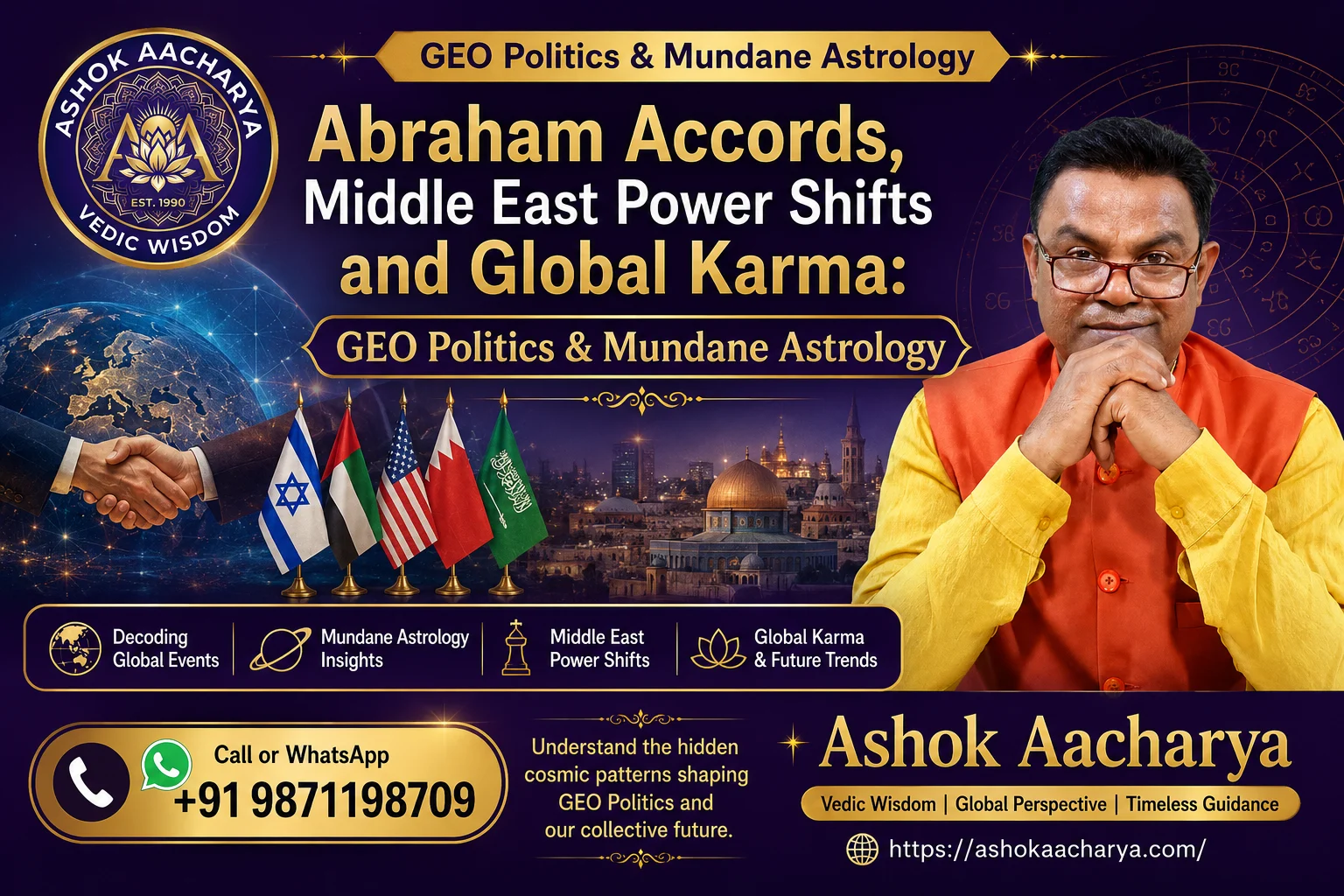
The Abraham Accords have been one of the most impactful GEO Politics moments of modern day Middle East. The agreements that were initially signed in 2020 between Israel, the United Arab Emirates, Bahrain and were expanded by further diplomatic engagement were a game-changer for regional diplomacy, trade, intelligence cooperation, and strategic alliances.
But things are much more complicated about geopolitics in 2025–2026. The Abraham Accords are now at the core of a new global GEO Politics power realignment that has morphed from an emblem of peace to a key factor in the current war in Gaza, the complexion of U.S. foreign policy, the dynamics of energy realignment, geopolitical concerns about the Red Sea and speculation about possible Saudi-Israel normalization.
Mundane astrology views these as not being individual political occurrences. They evoke deeper collective cycles associated with Saturn, Neptune, Pluto, eclipses and transivational cycles at the level of the civilizations at a global level, which are in progress these days.
The geopolitical outlook of the Abraham Accords is covered in this article along with the Mundane Astrology and GEO Politics, interpretation to bring about a well-informed, but spiritually educated perception on the future trajectory of the Middle East.
The Abraham Accords: A Major GEO Politics Turning Point
What’s the concept of the Abraham Accords?
In 2020, the Abraham Accords were mediated by the United States and Israel and a number of Arab countries established normal relations. The accords paved the way to:
- Economic cooperation
- Security coordination
- Intelligence sharing
- Technology partnerships
- Energy collaboration
For most of the time, this involved a combination of global and domestic tourism and infrastructure development.
The deals were a remarkable change as several Arab countries took one step further than the conventional stance of refusing to normalize with Israel until a solution had been reached for Palestine.
The agreements transformed regional diplomacy in a new direction, forming a new strategic partnership based on the following:
- Regional stability
- Counterbalancing Iran
- Economic modernization
- Technological cooperation
- Maritime security
- Energy diversification
Why the Abraham Accords Matter in 2026 GEO Politics
The Middle East Is Entering a New Power Cycle
Oil is no longer all the Middle East officials are concerned with. Today, the area is more and more influenced by:
Technology and AI Diplomacy
The UAE and Saudi Arabia are among countries taking an aggressive stance on AI, smart buildings and infrastructure, digital governance and international investment networks.
Multipolar GEO Politics Is Expanding
The world is shifting from the GEO Politics power of the USA to multipolarity with:
- China
- Russia
- Gulf nations
- India
- regional power blocs
Energy Transition and GEO Politics
The electricity system has been vital and is already undergoing rapid transformation in the Gulf with a growing reliance on:
- tourism
- logistics
- fintech
- clean energy
- strategic sovereign investments
Security Realignment
The Red Sea, Strait of Hormuz and Eastern Mediterranean are extremely sensitive strategic areas having a bearing on:
- shipping routes
- oil markets
- military alliances
- global inflation trends
This architecture of the Abraham Accords is emerging as a geopolitical framework for stabilisation of these changes.
Mundane Astrology Behind the Abraham Accords
Pluto in Aquarius and Global GEO Politics Restructuring
Pluto’s passage through Aquarius is one of the biggest and most significant astrological events of the present time.
In one of the mundane forms of astrology Pluto signifies:
- power restructuring
- hidden influence
- transformation
- strategic control
- collective psychological shifts
Aquarius governs:
- networks
- alliances
- technology
- collective systems
- diplomacy
- global connectivity
The marriage of these two signals is a strong sign of the reform of the old geopolitical blocs.
It’s clear that the themes of the Abraham Accords are classic Pluto in Aquarius themes:
- unconventional alliances
- Provide resources for strategic partnerships that are beyond ideology.
- technology-driven diplomacy
- intelligence cooperation
- regional power consolidation
In history Pluto has moved phase at the time of the following:
- global institutional restructuring
- new political frameworks
- Modification of the economic power influences,
- emerging ideological systems
Now, the Middle East is entering into the cycle of change.
Saturn-Neptune in Aries and New GEO Politics Identity
A noteworthy astrological conjunction that might affect the year of 2025-2026 is the conjunction of Saturn in Aries with Neptune in Aries.
Astrological Meaning
Saturn
- Represents:
- governments
- structure
- institutions
- law
- national boundaries
Neptune
Represents:
- ideology
- illusion
- spirituality
- mass psychology
- collective dreams
Aries
Represents:
- war
- sovereignty
- leadership
- military assertion
- national identity
This confluence of rare occurrences can sometimes result in times when countries redefine:
- identity
- military doctrine
- alliances
- ideological direction
The Abraham Accords are part of just this global transformation.
Israel, Gulf Nations & Mundane Astrology in GEO Politics
Why Economic Diplomacy Is Increasing
But, Mundane Astrology , the time of 2025-26 is auspicious for: Jupiter in the key financial and trade sector.
- international agreements
- cross-border investment
- infrastructure growth
- aviation expansion
- tourism diplomacy
This is already reflected in:
- developing ties with the EU and other countries on economic and security issues
- technology collaboration
- cybersecurity partnerships
- energy investment discussions
- transportation corridor projects
In spite of political turmoil, economic cooperation and possibilities for practical survival alliances are likely to grow further, as the bigger planetary cycles favor survival alliances more than ideological one-fits-all thinking.
Saudi Arabia and Future GEO Politics
Will Saudi-Israel Normalization Eventually Happen?
This is arguably among one of the top searched questions of global geopolitics.
On the one hand, from a fact level;
- Various issues relating to normalization frameworks have been discussed on and off.
- Based on a sense of security, guarantees are still at the heart of the business.
- The issue of Palestinian statehood has yet to be resolved
- This escalation potential adds to the challenges of negotiations on a regional level.
On the surface of things, from a mundane astrology point of view, the answer is not a straightforward “no” or “yes.
Indicators Supporting Eventual Diplomatic Progress
- The expansive nature of Jupiter suggests strategic expansion and diplomacy.Jupiter’s signifying is of strategic expansion diplomacy.
- The moon Pluto is promoting restructuring within regions.The Pluto moon is stimulating reformation within the regions.
- That Saturn asks for long-term institutional structures.Saturn’s demand for long-term institutional structures.
- Uranus & Conventional alliances are accelerating rapidly in the sky.Uranus & Conventional alliances = accelerating fast in the sky.
Indicators Causing Delays
While the ideology of Neptune was growing, the confusion increased.
- Neptune was adding to the ideological confusion.
- A couple of eclipse cycles have made it possible for public emotions to heighten.
- Mars’ qualities of conflict and conquest spark military escalation moments
- undefined local political tensions
Therefore, Mundane Astrology suggests:
- Slowly rising levels are still possible as a trend.There is still a possibility for a slowly rising trend.
- But, rapid progress could be followed by further setbacks and backslides until stabilization is reached.
Iran-Israel Tensions in GEO Politics
Why the Region Remains Volatile
The tension between Iran and Israel has to be considered when talking about the Abraham Accords.
Today the area is experiencing multiple stresses of:
- proxy conflicts
- missile escalation risks
- cyber warfare
- maritime tensions
- ideological polarization
Eclipses every other cycle over the Aries-Libra themes were amplified in the last few cycles:
- confrontation
- alliance redefinition
- military positioning
- leadership pressure
Collective Mundane Astrology often delves into the unspoken karmic dynamics to reveal themselves in mundane astrology.
So far, the Middle East is facing:
- historical memory resurfacing
- ideological fatigue
- generational transition
- power redistribution
That is why at the same time, both diplomatic deals can be in place with an escalation of conflict.
Public Psychology and GEO Politics
The Spiritual Dimension of GEO Politics
Political analysis is fraught with pitfalls, but one of the greatest is the failure to take collective psychology into account.
The science of mundane astrology includes the analysis of the planets’ movements in determining the influence on:
fear
- nationalism
- optimism
- ideological polarization
- economic confidence
- social unrest
It seems that humanity is becoming aware that it has entered an era of transition in its psychology, with the following characteristics of the current planetary environment:
- Insecurity towards old institutions
- Seek greater levels of belonging and connectedness to others and to God.
- technological acceleration
- spiritual uncertainty
- geopolitical fragmentation
The idea behind the Abraham Accords is to bring stability in the midst of that instability.
If only transactional politics, however, are used as the basis for a karmic agreement, such arrangements are unlikely to lead to lasting peace in the absence of:
- cultural integration
- public trust
- economic inclusivity
- psychological healing
It’s here that the next part of the Middle East diplomacy will play a crucial role.
Economic Impact of GEO Politics and Abraham Accords
Trade Corridors and Financial Influence
Increasingly, the agreements are associated with:
- logistics corridors
- shipping infrastructure
- investment partnerships
- energy transportation
- technology ecosystems
Astrologically, Uranus in Taurus is keeping the typical economic systems in turmoil and promoting:
- financial innovation
- digital banking
- energy restructuring
- unconventional economic alliances
This favors:
- sovereign wealth cooperation
- fintech growth
- AI infrastructure investment
- smart city growth in the Gulf countries
Middle East is evolving to become more than just an oil-rich area, and a strategic investment hub for the world.
Future Predictions: Mundane Astrology & GEO Politics 2026–2030
According to Mundane Astrology what does it say about the Abraham Accords?
- Diplomatic Expansion Continues
Even if formal cooperation with its various aspects is taken time, it is likely that more informal cooperation between regions takes place.
- Economic Integration Deepens
Partnerships in the areas of commerce, aviation, travel and technology are expected to increase greatly.
- Public Resistance Will Fluctuate
People’s opinion within the country can at times pose resistance or delays in several countries.
- Military Volatility continues to be possible:
But Mars and eclipse cycles indicate there will be a few bumps in the road until the late 2020s.
- The Middle East will grow more multipolar.
The external factors affecting the diplomatic equations will be more and more shaped by China, India, the Gulf countries and the regional alliances.
- Spiritual and Cultural Narratives will Matter More
The requirement to incorporate spiritual and cultural narratives to support and enhance learning.
Stability could very well depend, not just on governments, but on the psychological acceptance of the population to the possibility of living together in the long run.
Key Takeaways
- The Abraham Accords are more than simply a diplomatic deal.
- They represent a re (geo)forwarding of Middle Eastern geopolitical identity.
- Pluto in Aquarius brings about alliances and change within the region which are out of the norm.
- Saturn-Neptune cycles are about the ideology / leadership redirection on a global scale.
- Diplomacy of the economy will undoubtedly further develop even amidst clashes.
- Iran-Israel relations are another significant potential destabilizing factor.
- Mundane Astrology predicts that change will occur, but not as much as for an instant peace.
- The collective psychology and sentiment of the people will be of great importance in the coming years.
Conclusion
The Abraham Accords are more than just documents of policy making. These are the beginnings of a global transition of the civilizational order.
With the current,”strategic alliance” era, there is a greater trend towards thinking beyond ideology and more towards forming economic, technological, survival, and regional stability-based alliances.
According to mundane astrology, the next ten years will not be a time of war or peace. It seems Mundane Astrology analysis that the next 10 years will NOT be a peace or war decade. Instead, it will be built based on the changes in the negotiations of power, identity, economy, public psychology and collective karma.
These planetary cycles serve as a profound and expansive understanding that can enhance the interpretation of the world.To understand the planetary cycles would enable the policymakers, investors, political watchers, as well as spiritually engaged thinkers, to interpret the global developments more deeply and more clearly.
Frequently Asked Questions (FAQ)
What are the Abraham Accords?
The Abraham Accords are diplomatic agreements that normalized relations between Israel and several Arab nations, including the United Arab Emirates and Bahrain. The agreements marked a significant shift in Middle Eastern diplomacy and regional cooperation.
Why are the Abraham Accords important?
The Abraham Accords are considered important because they opened new opportunities for diplomatic cooperation, trade, investment, technology partnerships, tourism, and regional security collaboration in the Middle East.
Which countries signed the Abraham Accords?
The original Abraham Accords involved Israel, the United Arab Emirates, and Bahrain. Later, Morocco and Sudan also joined normalization efforts through separate agreements supported by diplomatic negotiations.
What role did Donald Trump play in the Abraham Accords?
Donald Trump and his administration played a central role in facilitating negotiations that led to the signing of the Abraham Accords in 2020. The agreements became a major component of U.S. Middle East foreign policy during his presidency.
How do the Abraham Accords affect Middle East geopolitics?
The agreements have influenced diplomatic relationships, economic partnerships, regional security discussions, and strategic alliances. They continue to shape debates about the future balance of power in the Middle East.
Could the Abraham Accords expand to include more countries?
Many geopolitical analysts believe additional countries could potentially establish formal relations with Israel in the future. The pace and scope of expansion depend on regional political developments and diplomatic negotiations.
People Also Ask (Q&A)
How could the Abraham Accords influence future global power shifts?
The Abraham Accords have the potential to reshape regional alliances, economic partnerships, energy cooperation, and security frameworks. Their long-term impact could extend beyond the Middle East and influence broader geopolitical trends.
Why is the Middle East crisis closely watched by global powers?
The Middle East remains strategically important because of its location, energy resources, trade routes, security concerns, and geopolitical influence. Regional developments often affect global markets and international diplomacy.
Why does Ashok Aacharya analyze geopolitical developments such as the Abraham Accords?
Since 1990, Ashok Aacharya studies geopolitical events through the lens of strategic trend analysis, mundane astrology, astrological research, local and global leadership cycles, and long-term global developments. His focus is on identifying emerging patterns that may influence future economic, national and global trade, political events, war,and social trends.
About Ashok Aacharya
Ashok Aacharya is a Spiritual Wellness Strategist, Strategic Forecaster, Global Trends Analyst, Author, Speaker, and Vedic Astrology Researcher. Since 1990, he has advised corporate leaders, entrepreneurs, and high-net-worth individuals worldwide — integrating Vedic Astrology, Vastu Shastra, Spirituality and Numerology with business strategy and behavioral insight. Guided by the philosophy Ancient Wisdom. Modern Strategy. Better Decisions, his work favors critical thinking over superstition. Featured in The Times of India, Speaking Tree, Nav Bharat Times, NBT ASTRO, Business Standard, Zee News, News Nation, and Amar Ujala an more
Explore Further
If you’re planning a new office layout or reassessing an existing one, personalized guidance can help translate these principles into a plan suited to your specific space, team, and business goals.
Website: https://ashokaacharya.com/ WhatsApp: +91-9871198709