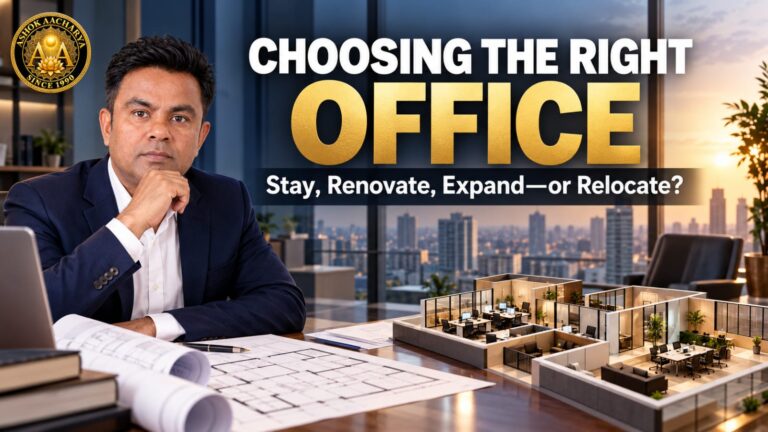
Office Vastu for Startups & Corporates: A Practical Guide to Seating, Cabins & Workspace Planning
Office Vastu is the traditional Indian science of spatial alignment applied to commercial workspaces — covering entrance direction, seating placement, cabin layout, and cash-handling areas. Classical principles suggest leadership cabins in the south-west, cash counters in the north, and entrances facing north or east. Used thoughtfully, it becomes a planning lens for clarity, flow, and decision-making — not a guarantee of financial results.
Introduction
Founders and CFOs rarely ask “should I care about Vastu?” in the abstract. They ask it while signing a lease, designing a cabin layout, or deciding where the accounts team should sit. The question is practical, and it deserves a practical answer.
This guide is written for that moment. It explains what classical Office Vastu principles actually say about seating, cabin placement, and cash-flow zones, where those principles come from, where evidence ends and tradition begins, and how a business leader can apply this responsibly — as one input among many, not as a substitute for architectural, financial, or legal judgment.
Whether you are setting up a startup office, relocating a corporate team, redesigning a leadership workspace, or reviewing a commercial floor plan, Office Vastu can be approached as a complementary planning framework. It should support thoughtful decision-making alongside professional architectural, engineering, financial, and legal considerations.
What Is Office Vastu?
Vastu Shastra is a classical Indian body of knowledge dealing with the orientation, proportion, and layout of built spaces. Office Vastu is its application to commercial environments — factories, startups, corporate floors, and retail spaces.
At its core, classical Vastu organizes a space around eight directions and their traditionally associated qualities: north-east for clarity and beginnings, south-west for stability and authority, north for flow and resources, and so on. In a workplace context, this translates into recommendations for where the founder sits, where the team works, where meetings happen, and where money is counted or stored.
It is important to be direct about what this is and isn’t. Vastu is a traditional design framework, not an empirically validated science of business performance. There is no peer-reviewed evidence that desk orientation causes revenue growth. What it offers is a structured way to think about workspace psychology, movement, natural light, and symbolic clarity — factors that legitimate workplace design research does connect to focus, morale, and decision quality.
Why Does Office Vastu Matter to Founders and Executives?
Three genuine reasons explain why serious business leaders still engage with this framework, beyond belief alone.
It forces a design conversation that often gets skipped. Most offices are laid out around furniture budgets and floor plans, not around how leaders think, how teams collaborate, or how visitors experience the space. Vastu principles, applied as a checklist, prompt that conversation early.
It carries psychological and cultural weight for many stakeholders. In markets across South Asia and the diaspora, employees, partners, and clients may notice — consciously or not — whether an office “feels right.” Ignoring this entirely can be as strategically costly as over-relying on it.
It overlaps meaningfully with sound workplace design. Natural light near work zones, clear sightlines from leadership areas, minimal clutter near entrances, and quiet zones away from high traffic are recommended by both classical Vastu and modern workplace ergonomics — for different stated reasons, but with similar practical outcomes.
How Office Vastu Principles Work
Classical Vastu treats a building as a grid mapped to eight compass directions plus the center. Each zone is traditionally associated with an element and a quality of activity.
- North-East (Ishaan): Associated with clarity and new beginnings — often recommended for reception areas or meditation/quiet corners.
- East: Associated with growth and visibility — often used for open work areas.
- South-East (Agneya): Associated with energy and transformation — traditionally suited to electrical systems, pantries, or server rooms.
- South: Associated with recognition and stability — sometimes used for HR or administration.
- South-West (Nairritya): Associated with authority and command — classically recommended for the promoter’s or senior leadership cabin.
- West: Associated with steady effort — often suited to finance or operations teams.
- North-West (Vayavya): Associated with movement and change — traditionally linked to sales, marketing, or guest-facing functions.
- North: Associated with resources and flow — classically favored for cash counters, treasury, or accounts.
These associations come from classical texts and centuries of practitioner tradition. Modern interpretation adapts them to realities texts never addressed — glass towers, open-plan floors, co-working spaces, and remote-first teams — which is where a researcher’s judgment, not just the text, comes into play.
Key Principles for Seating, Cabins, and Cash Flow
Leadership and Founder Seating
Classical Vastu generally recommends the founder or senior-most decision-maker sit in the south-west portion of the office, facing north or east while working. The reasoning given traditionally is that the south-west position offers a psychological sense of being anchored, with visibility over the space — a principle that also has a straightforward practical parallel in workplace design, where leaders are often seated to observe rather than have their backs to the room’s entry point.
Employee and Team Seating
Open work areas are traditionally favored in the north, east, or north-east zones, with desks arranged so employees generally face north, east, or north-east while working. Aisles and walkways are kept clear, and workstations are not placed directly beneath exposed structural beams — a guideline that also aligns with straightforward ergonomic and safety sense.
Cabins and Meeting Rooms
Meeting rooms are traditionally placed in the north-west, since this direction is associated with dynamic discussion and negotiation. Cabins for department heads are generally distributed in the west and south zones, supporting the south-west leadership cabin without overshadowing it.
Cash Flow, Accounts, and Treasury
This is the area most business owners ask about directly. Classical Vastu recommends that cash counters, safes, and accounts departments be located in the north — the zone traditionally associated with resource flow — with the safe or cash box ideally opening toward the north or facing south when in use, and never left visibly open toward the main entrance.
It should be stated plainly: there is no scientific basis for treating desk or safe orientation as a determinant of actual cash flow, which is governed by sales performance, receivables management, pricing, and financial discipline. What this principle can reasonably offer is a symbolic and organizational cue — treating the treasury function as a distinct, secured, well-lit zone rather than an afterthought tucked into a corner.
Entrance and Reception
North- or east-facing main entrances are classically preferred, kept well-lit, uncluttered, and free of directly opposing sharp structural corners. The reception desk is often positioned so the receptionist faces the entrance rather than sitting with their back to it.
What Should You Avoid?
- Placing the founder’s cabin directly opposite the main entrance in a way that exposes them to constant foot traffic and visual distraction.
- Positioning the accounts or cash-handling desk in a dark, cramped, or high-traffic corner.
- Seating employees with their backs to the main door for extended, unbroken periods, which most ergonomic and psychological research also associates with lower comfort and sustained low-grade stress.
- Cluttered entrances and blocked walkways, which both classical Vastu and basic workplace safety standards discourage.
- Treating any single directional adjustment as a substitute for addressing an actual operational or financial problem.
How Can You Apply This in Real Life? A Practical Framework
Use this as a sequence when designing or auditing an office layout.
- Map the existing floor plan Map the existing floor plan against the eight directions using an appropriate compass-based measurement method rather than assumption. Digital compass apps can provide a useful initial reference, but accuracy may be affected by building materials, nearby electronics, and magnetic interference. For detailed assessments, the measurement method should be selected according to the specific property and purpose of the review.
- Identify the founder/leadership seating zone and check its alignment against the south-west principle; note constraints (structural columns, lease limitations, shared floors).
- Review team seating for open, well-lit placement in north, east, or north-east zones, with clear sightlines and no desks under exposed beams.
- Locate the accounts/treasury zone in the north where feasible, and separately verify it meets basic security and financial-control standards.
- Audit the entrance and reception for clarity, lighting, and an unobstructed, welcoming first impression.
- Distinguish must-fix items from ideal-but-optional items — structural changes are rarely justified for Vastu alone; furniture and seating changes usually are low-cost and low-risk.
- Document the rationale for each change so it can be evaluated on its own practical merits, separate from symbolic reasoning.
Ashok Aacharya Strategic Insight
Most Vastu consultations stop at “where should things go.” The more useful question for a founder is: what does this layout decision reveal about how I actually want authority, information, and money to move through this organization?
A south-west leadership cabin is not powerful because of a compass reading — it becomes powerful when it is paired with an actual decision-making process that matches its symbolism: visibility without micromanagement, accessibility without chaos. Use directional placement as a structured prompt to design the organizational behavior you want, not as a substitute for designing it.
The most valuable question is not whether a layout is simply “Vastu compliant,” but whether the space supports the organization’s intended patterns of leadership, collaboration, concentration, communication, and decision-making. A thoughtful workspace should be evaluated not only by directional principles but also by how effectively it supports the people and activities within it.
Example: A Composite Scenario
A 40-person fintech startup relocating to a new floor found its original layout placed the founder’s desk facing the entrance with constant interruptions, and the accounts team squeezed into a windowless side room. Applying Vastu principles as a planning lens, the leadership team repositioned the founder’s desk to a quieter south-west corner facing the room, moved accounts to a better-lit north-facing zone with proper access control, and reorganized meeting rooms near the entrance for visitor-facing discussions. The physical changes improved daily focus and reduced interruptions — outcomes attributable to better workspace ergonomics and security practice, which happened to align with classical Vastu recommendations in this case. No claim is made, or should be made, that the layout caused specific revenue outcomes.
Myth vs. Reality
Myth: “Vastu-correcting the office guarantees higher profits.”
Reality: No spatial layout can substitute for product-market fit, sales execution, or financial discipline. Vastu can inform design decisions; it does not run the business.
Myth: “Every office must be structurally rebuilt to follow Vastu.”
Reality: Classical Vastu offers a hierarchy of remedies — most consultants and researchers prioritize furniture placement, color, lighting, and decluttering long before recommending structural change, which is rarely justified or necessary.
Myth: “Vastu and modern office design are in conflict.”
Reality: Many classical recommendations — clear entrances, good natural light near workstations, leaders positioned with a clear view of the room — closely track sound ergonomic and architectural practice, arrived at through different reasoning traditions.
Limitations and Responsible Use
Office Vastu is best used as a complementary framework for reflection, workspace planning, and organizational design conversations. It should not replace the advice of licensed architects, structural engineers, financial controllers, or legal advisors, particularly regarding lease negotiations, building safety, fire codes, or statutory compliance. Any specific business outcome — revenue, funding, hiring, litigation — depends on factors far beyond office layout, and no responsible practitioner should suggest otherwise.
FAQ
Does the direction of my office entrance actually affect my business performance?
There is no established scientific evidence linking entrance direction to business performance. Classical Vastu associates certain directions with favorable qualities, and many leaders find value in the design discipline this prompts — but performance is driven by strategy, execution, and market conditions.
Where should the cash counter or safe be placed according to Vastu?
Classical Vastu recommends the north zone for cash counters and safes, ideally in a well-lit, secure area not visible from the main entrance. This should be paired with, not substituted for, proper financial security controls.
Can I apply Vastu principles in a rented office or shared co-working space?
Yes. Most practical Vastu adjustments — desk orientation, seating placement, declutter, lighting, and furniture arrangement — require no structural changes and can be applied within a leased or shared space.
Is it necessary to redesign the entire office to follow Vastu?
No. Classical practice generally prioritizes low-cost, non-structural changes first. Full redesigns are the exception, not the starting recommendation.
How is Office Vastu different from Vastu for homes?
Home Vastu focuses on rest, relationships, and personal well-being zones, while Office Vastu focuses on authority, decision-making, cash flow, and team collaboration zones — the directional framework is shared, but the functional priorities differ.
Conclusion
Office Vastu, understood correctly, is not a shortcut to profitability — it is a structured lens for thinking about how a workspace supports the way leaders want their organization to function. Seating, cabin placement, and cash-flow zones are practical decisions every business already has to make; classical principles simply offer one more disciplined way to make them thoughtfully. Applied with critical thinking rather than superstition, this is exactly where Ancient Wisdom meets Modern Strategy — for Better Decisions.
About Ashok Aacharya
Ashok Aacharya is a Spiritual Wellness Strategist, Strategic Forecaster, Global Trends Analyst, Author, Speaker, and Vedic Astrology Researcher. Since 1990, he has advised corporate leaders, entrepreneurs, and high-net-worth individuals worldwide — integrating Vedic Astrology, Vastu Shastra, Spirituality and Numerology with business strategy and behavioral insight. Guided by the philosophy Ancient Wisdom. Modern Strategy. Better Decisions, his work favors critical thinking over superstition. Featured in The Times of India, Speaking Tree, Nav Bharat Times, NBT ASTRO, Business Standard, Zee News, News Nation, and Amar Ujala an more
Explore Further
Planning a new office, relocating your business, or redesigning an existing workspace? A professional Office Vastu review can help evaluate traditional spatial principles alongside the practical requirements of your property, team, operations, and long-term objectives.
Explore Business & Commercial Vastu Consultation
Website: https://ashokaacharya.com/
For consultation or professional enquiries:
WhatsApp / Phone: +91-9871198709