Why Smart People Still Make Bad Decisions in the Age of AI
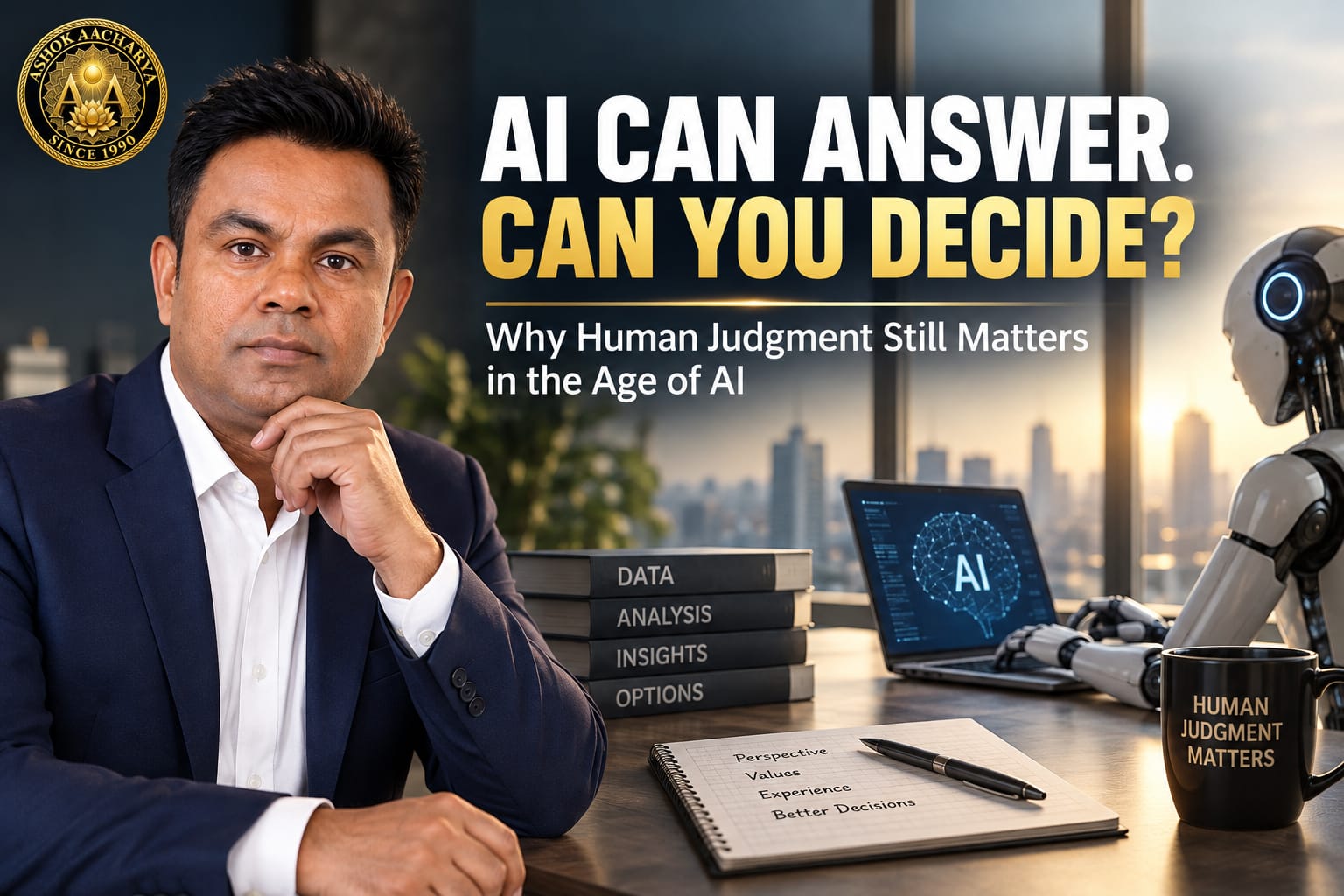
AI can give us an answer before we have fully understood the question.
That may be one of the defining challenges of the AI era.
A professional facing a difficult career choice can ask AI to compare options. An entrepreneur can ask it to evaluate a business idea. An investor can ask it to summarize market information. A leader can ask it to generate scenarios.
The speed is extraordinary.
But speed creates a subtle danger: we may become better at producing answers without becoming better at deciding.
The real question is therefore not whether AI can make us more informed.
It is whether we can remain thoughtful, independent and responsible while using it.
Why This Matters Now
AI is moving rapidly from a tool for retrieving information toward a tool that can participate in analysis, recommendations and decision-support.
Recent research is beginning to examine what happens when people rely heavily on such systems. A September 2026 study found an association between greater trust in AI decision-support and reduced self-reported independent evaluative effort. Importantly, the researchers describe the study as cross-sectional and based on self-reported data, so it does not establish that AI use causes a decline in judgment.
Another recent study of human-AI judgment emphasizes the importance of preserving human agency, contextual reasoning, transparency and appropriate allocation of tasks between humans and AI.
These findings do not mean that AI is making people less intelligent.
They point to a more interesting issue:
What happens when convenience begins to replace reflection?
That question is much bigger than technology.
It is a question about human behavior.
The Deeper Problem Is Not Lack of Information
For most of human history, difficult decisions were constrained by a lack of information.
Today, the problem is increasingly the opposite.
We have too much information.
AI can summarize ten reports before breakfast. It can produce multiple scenarios in seconds. It can present arguments for and against a decision almost instantly.
But information has never been the same thing as wisdom.
Consider someone deciding whether to leave a secure career to start a business.
AI can help calculate potential revenue, identify competitors, analyze the market and construct financial scenarios.
But it cannot simply determine:
- How much uncertainty the person should accept
- What responsibility they have toward their family
- Whether the desire for change is temporary or deeply considered
- What kind of life they actually want
- Which risks are acceptable
- What they would regret not attempting
Those are judgment questions.
And judgment is where the human being re-enters the picture.
AI Can Expand the Options. It Cannot Decide What Matters Most.
This is where I believe the conversation around AI and decision-making needs to become more mature.
The important question is not:
“Can AI make decisions?”
It clearly can participate in decision processes.
The better question is:
“Which parts of a decision should we delegate, and which parts should remain deeply human?”
AI is exceptionally useful for expanding the field of possibilities.
Ask it:
“What alternatives am I overlooking?”
“What assumptions are weak in my plan?”
“What could cause this strategy to fail?”
“What arguments would someone who disagrees with me make?”
“What scenarios should I prepare for?”
These are powerful uses of AI.
The mistake is asking:
“Tell me what I should do.”
before asking yourself what you actually value.
A Vedic Perspective: Timing Is Not the Same as Action
There is an interesting parallel in Vedic thought.
Traditional Vedic astrology places considerable emphasis on timing.
But recognizing a period of possibility is not the same as deciding what to do with it.
This distinction is particularly relevant in the age of AI.
Technology can tell us what is possible.
It can help identify patterns.
It can estimate scenarios.
It can accelerate analysis.
But possibility still requires judgment.
In a responsible interpretation of Vedic astrology, planetary periods and transits are not substitutes for practical analysis or personal responsibility. They can be treated as a traditional framework for reflection around timing, tendencies and circumstances—not as empirical proof of a predetermined outcome.
That distinction matters.
Because if we replace one form of unquestioned certainty with another, we have not actually improved our decision-making.
We have simply changed the source of authority.
Spiritual Intelligence Adds Another Dimension
Spiritual intelligence, in my view, is not about withdrawing from modern technology.
It is about developing the inner capacity to use external tools without becoming psychologically dependent on them.
A useful question is:
Can I use a powerful tool without surrendering my own discernment?
That question applies to AI.
It also applies to social media, financial advice, expert opinions, predictive systems and even traditional wisdom.
The mature position is neither blind acceptance nor blind rejection.
It is discernment.
You can listen without obeying.
You can learn without surrendering judgment.
You can use technology without outsourcing responsibility.
That is an increasingly important form of intelligence.
Why Smart People Are Not Immune
Intelligence itself does not guarantee good decisions.
In fact, intelligent people can sometimes construct very sophisticated explanations for decisions they have already emotionally committed to.
AI can make this easier.
If someone already wants a particular outcome, they can prompt AI repeatedly until they receive an argument that supports it.
The technology then becomes an amplifier of confirmation bias.
This creates a useful discipline:
Don’t ask AI only to support your decision. Ask it to challenge your decision.
Try:
“What would make this decision wrong?”
“What evidence would contradict my current view?”
“What am I emotionally reluctant to consider?”
“What would a skeptical expert say?”
“What information would I need before acting?”
These questions force the decision-maker back into the process.
The Five-Stage Decision Discipline
For important decisions, I recommend a simple sequence.
1. Define
What exactly are you deciding?
Not the emotion surrounding the decision.
Not the story you are telling yourself.
The actual decision.
2. Explore
Use AI to expand your thinking.
Generate options.
Identify risks.
Compare scenarios.
Find questions you have not considered.
3. Verify
Check important information independently.
AI can make errors.
So can people.
Verification is part of responsible decision-making.
4. Interpret
Now bring in the human dimension.
What does this information mean in your particular circumstances?
What are your priorities?
What constraints matter?
What are you willing to accept?
This is where context becomes more important than raw information.
5. Decide
Take responsibility for the choice.
Do not hide behind the technology.
Do not blame the algorithm.
Do not treat a recommendation as destiny.
The final decision belongs to the decision-maker.
Where Vastu and Numerology Can Fit — and Where They Should Not
The same principle applies to other traditional frameworks.
Vastu Shastra can be explored as a traditional spatial framework when thinking about how people experience homes, workplaces and environments.
Numerology can be approached as a traditional interpretive system for reflecting on names, identity and symbolic meaning.
Neither should replace property due diligence, financial analysis, architectural expertise, legal review or other professional evaluation.
This is important because responsible wisdom should expand perspective—not eliminate practical responsibility.
The strongest approach is therefore integrative.
Data informs.
Experience contextualizes.
Wisdom questions.
Judgment decides.
The Future May Belong to Better Decision-Makers, Not Just Better AI Users
The AI conversation often focuses on productivity.
How much time can AI save?
How much work can it automate?
How quickly can it produce an answer?
These are legitimate questions.
But there is another question that may ultimately matter more:
What kind of decisions are we making with all that additional speed?
If AI allows us to process information ten times faster but causes us to reflect ten times less, we may have improved efficiency without improving judgment.
The opportunity is different.
Use AI to widen the field.
Use research to establish facts.
Use experience to understand context.
Use wisdom to question assumptions.
And use human judgment to decide.
That is closer to what I mean by Decision Intelligence.
It is not simply having more information.
It is moving intelligently from:
Information → Interpretation → Context → Judgment → Decision
AI can strengthen several stages of that process.
It should not quietly take ownership of the entire process.
Five Questions to Ask Before Your Next Important AI-Assisted Decision
Before acting on an AI-generated recommendation, ask yourself:
1. What decision am I actually making?
2. What assumptions is this recommendation based on?
3. What important information might be missing?
4. What could happen if the recommendation is wrong?
5. Am I prepared to take responsibility for the outcome?
If you cannot answer those questions, you may not need another AI answer.
You may need a better question.
The Real Advantage in the Age of AI
AI is making information cheaper, faster and more accessible.
That changes the value of information.
But it may simultaneously increase the value of something harder to automate:
judgment.
The people who thrive in this environment will not necessarily be those who reject AI.
Nor will they necessarily be those who trust it most.
They will be those who know how to use powerful tools while retaining the ability to question, interpret, decide and take responsibility.
That is where modern technology and timeless wisdom can meet.
Not in replacing human judgment.
But in making human judgment more conscious.
AI can give you more answers.
Better decisions still require better questions.
And ultimately, the decision still belongs to you.
Frequently Asked Questions
Can AI make better decisions than humans?
AI can process large amounts of information, identify patterns and generate alternatives very quickly. But important decisions also involve context, values, priorities and accountability. AI is therefore best understood as a decision-support tool rather than an automatic replacement for human judgment.
How does AI affect human decision-making?
AI can improve access to information and analysis, but excessive reliance may reduce independent evaluation. Recent research has found an association between trust in AI decision-support and reduced self-reported evaluative effort, although that research does not establish causation.
How can I use AI without losing critical thinking?
Use AI to generate alternatives, challenge assumptions, analyze information and explore scenarios. Then verify important facts, apply your own context and priorities, and take responsibility for the final decision.
What is Decision Intelligence?
Decision Intelligence is an approach to improving decisions by combining information, analysis, context, judgment and responsible action. AI can support parts of the process, but human judgment remains important when interpreting circumstances and choosing how to act.
Can Vedic wisdom and AI be used together?
They can be approached as complementary frameworks with different purposes. AI can assist with information and analysis, while traditional Vedic frameworks can provide interpretive perspectives around timing, space, identity and reflection. Neither should replace evidence, professional expertise or practical due diligence.
About Ashok Aacharya
Ashok Aacharya is a Spiritual Wellness Strategist, Strategic Forecaster, Global Trends Analyst, Vedic Astrology & Vastu Shastra Researcher, Author & Speaker, and Advisor to Global Leaders Since 1990.
He bridges Vedic wisdom with contemporary strategic thinking to bring greater clarity to leadership, business, career, and important life decisions.
Ashok Aacharya’s media and public engagements include television appearances, expert interviews and commentary, talk shows, panel discussions, debates, podcasts, public lectures, keynote addresses, conference presentations, roundtables, articles, and digital programmes. His media presence includes Speaking Tree by The Times of India, NBT Astro by Navbharat Times, Zee News, News Nation, and Amar Ujala. His published media material also includes content distributed by ANI and published in Business Standard’s Press Releases section.