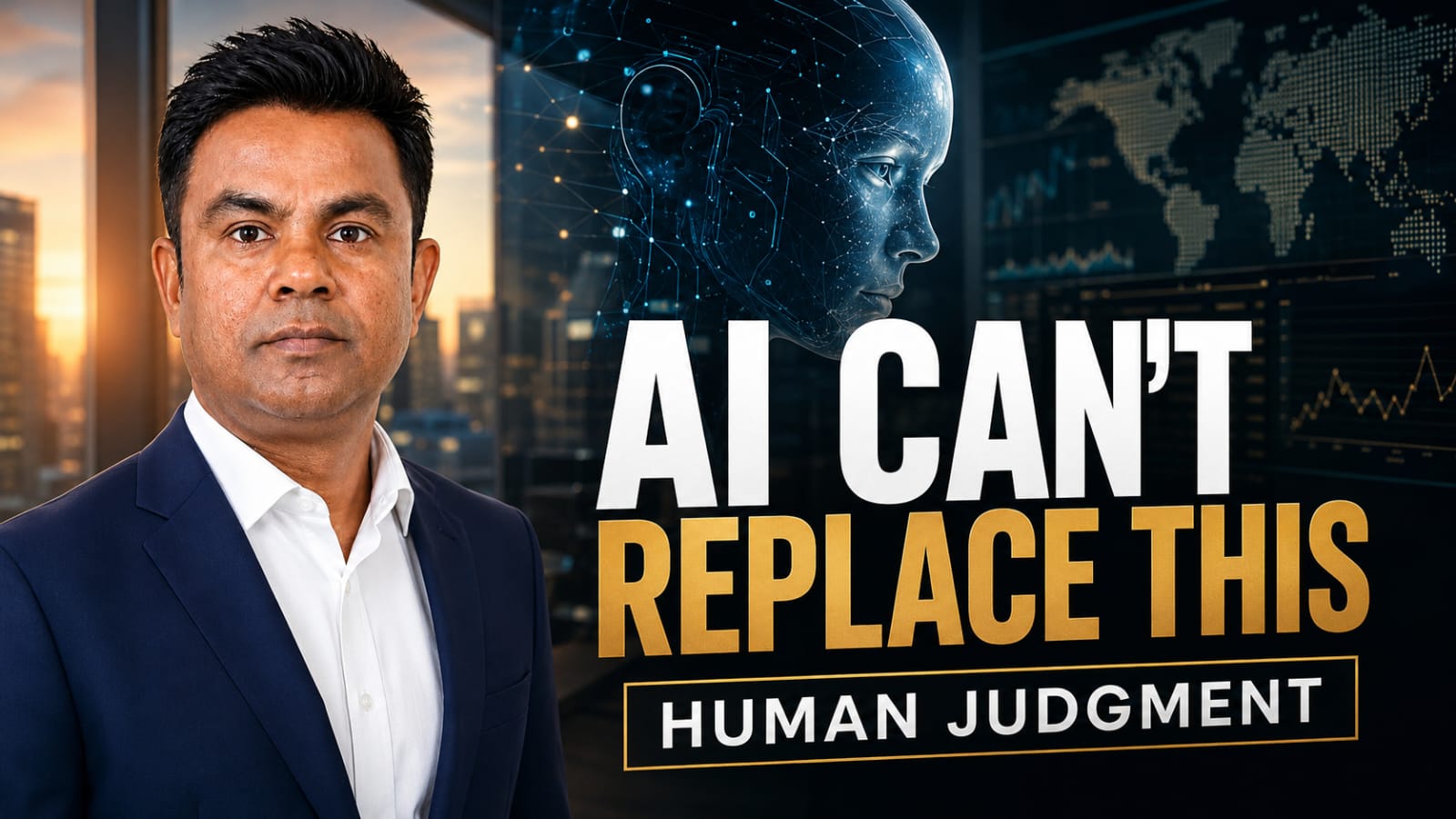
What AI Can’t Automate: The $1 Trillion Value of Human Judgment in 2026
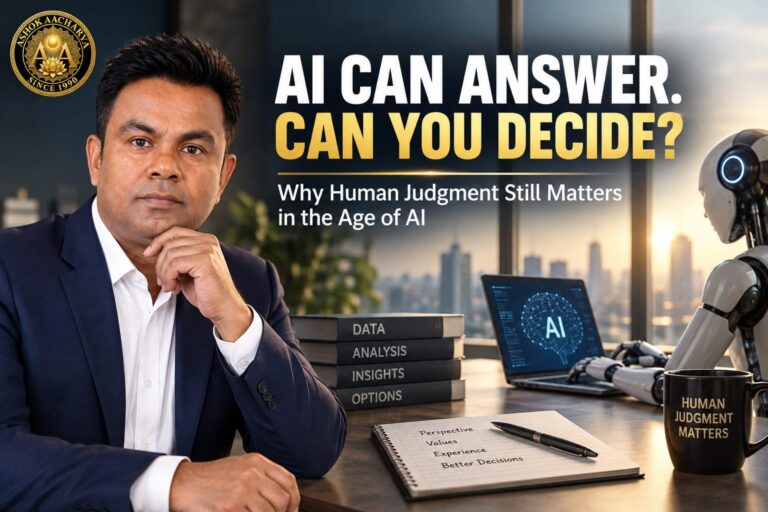
Artificial intelligence is becoming remarkably good at producing answers.
In 2026, AI can analyze data, summarize reports, generate software, create presentations, identify patterns, support research and automate increasingly complex workflows.
But one question is becoming more important:
If AI can increasingly tell us what we could do, who decides what we should do?
That is where human judgment becomes strategically valuable.
The idea of the “$1 trillion value” of human judgment is a strategic thesis, not a published global valuation. The point is simple: as AI makes information, analysis and execution increasingly abundant, the ability to apply context, values, responsibility and wisdom to important decisions may become one of the most valuable human capabilities.
AI Can Process Information. Judgment Gives It Meaning.
AI is exceptionally powerful at processing information.
But human judgment is more than information processing.
Judgment involves understanding:
- What information actually matters
- What the real problem is
- Which risks deserve attention
- What trade-offs are acceptable
- What cannot easily be measured
- Who will be affected
- When available evidence is insufficient
- When the best decision may be to wait
Consider a business leader deciding whether to enter a new market.
AI can analyze market size, competitors, pricing, customer behavior and financial projections.
But the final decision may also depend on company culture, leadership capacity, reputation, relationships, timing and long-term purpose.
Data can inform a decision. It cannot automatically define what matters most.
The Better Question Is Not “Will AI Replace Humans?”
The more useful question is:
Which decisions should AI automate, which should it support, and which should remain human-owned?
This distinction will become increasingly important for CEOs, founders, investors and professionals.
Routine, repetitive and measurable tasks are strong candidates for automation.
Research, analysis, forecasting and scenario generation can often be augmented by AI.
But decisions involving ethics, accountability, reputation, people, significant capital or long-term strategy require stronger human oversight.
The future is therefore unlikely to be simply human versus AI.
It will increasingly be human judgment amplified by AI capability.
Why Human Judgment May Become More Valuable
There is an important paradox in technological progress.
When intelligence becomes abundant, judgment can become scarce.
If every competitor can use powerful AI to generate business plans, marketing ideas, reports and strategic options, those outputs become less differentiated.
Competitive advantage moves to a deeper level.
Who asks the better question?
Who recognizes an overlooked risk?
Who understands the context?
Who knows when not to act?
Who can make a decision when the evidence is incomplete?
Who accepts responsibility for the consequences?
These are leadership questions.
The World Economic Forum’s Future of Jobs Report 2025 continues to identify analytical thinking as a critical skill while also emphasizing creative thinking, resilience, leadership and collaboration in a changing workplace.
The implication is important:
AI skills and human capabilities are becoming complementary rather than mutually exclusive.
What AI Cannot Responsibly Own
AI capabilities will continue to evolve, so claiming that technology can never perform a particular human function would be premature.
The more practical question is which responsibilities should remain human-centered.
1. Defining the Right Problem
AI can optimize a poorly defined objective.
A company may ask:
AI, how can we reduce customer-service costs?
A stronger leader might ask:
“Why are customers contacting us so frequently in the first place?”
The first question optimizes the existing system.
The second challenges the system.
Strategic judgment knows the difference.
2. Applying Values
Two strategies can have similar financial projections but very different consequences for employees, customers or society.
Choosing between short-term profit and long-term trust is not merely a mathematical exercise.
It reflects values.
AI can help illuminate the trade-off.
Humans must decide what they are willing to trade.
3. Taking Accountability
If an AI recommendation causes a major financial or reputational loss, the algorithm cannot meaningfully accept responsibility.
Someone must.
Every consequential AI-supported decision therefore needs clear human ownership.
4. Understanding Context
Not everything important appears in a spreadsheet.
Relationships, timing, organizational culture, human emotions, reputation and social dynamics can materially influence outcomes.
Context often determines whether an apparently rational decision is actually wise.
The Greatest Risk: Outsourcing Judgment
The biggest danger may not be AI becoming too intelligent.
It may be humans becoming too dependent.
An AI-generated answer can sound confident, detailed and persuasive even when its assumptions are incomplete or its conclusion is wrong.
This creates a dangerous psychological shortcut:
The AI said it, therefore it must be right.
That is not intelligence.
That is judgment outsourcing.
A better process is:
Human thinking → AI analysis → independent verification → human decision.
Use AI to challenge your thinking, not replace it.
A Practical Framework for Leaders
Before accepting an important AI recommendation, ask five questions:
1. What does the AI know?
Identify the evidence and assumptions.
2. What does the AI not know?
Look for missing context and uncertainty.
3. What could go wrong?
Consider downside scenarios.
4. Who bears the consequences?
Identify the people and stakeholders affected.
5. Am I making this decision—or merely approving the AI’s decision?
That final question may be the most important.
Human Judgment and Spiritual Intelligence
There is also a deeper dimension to decision-making.
People do not make decisions through logic alone. Ego, fear, greed, pressure, ambition and confirmation bias can influence even highly intelligent individuals.
This is where Spiritual Intelligence can become relevant.
In practical terms, spiritual intelligence involves greater awareness of purpose, values, consequences, responsibility and self.
As AI becomes better at answering questions, humans may need to become better at deciding which questions deserve to be asked.
Vedic Astrology, Vastu Shastra and Numerology can be approached as complementary frameworks for reflection and pattern awareness—not as substitutes for evidence, professional expertise or rational analysis.
The principle should remain simple:
Technology improves capability. Awareness improves the decision-maker.
The Real Competitive Advantage of 2026
The organizations that succeed in the AI era will not necessarily be those that automate the most.
They will be those that build the best decision architecture.
They will know what to automate, what to augment, what to verify and what to protect.
They will use AI for speed and scale while preserving human judgment for context, values and accountability.
The defining question of the AI era may therefore not be:
How intelligent can machines become?
It may be:
How wisely will humans use increasingly intelligent machines?
AI can increase the speed of analysis.
It can increase productivity.
It can expand what individuals and organizations are capable of achieving.
But speed is not wisdom.
Information is not judgment.
Automation is not responsibility.
The real opportunity is not to choose between humans and AI.
It is to build a future where AI makes human judgment more powerful—not less necessary.
If you are an entrepreneur, business leader, investor, policymaker, or professional preparing for the future, now is the time to rethink not only technology but also leadership, decision-making, and long-term strategy.
About Ashok Aacharya
Ashok Aacharya is a Spiritual Wellness Strategist, Strategic Forecaster, Global Trends Analyst, Author, Speaker, and Vedic Astrology Researcher | Since 1990. His research-driven insights have been featured in The Times of India (Speaking Tree), Business Standard, Zee News, Navbharat Times (NBT Astro), Amar Ujala, News Nation, and News India 24×7.
People Also Want to Know
1. Can AI replace human judgment?
No, not completely. AI can analyze information, identify patterns, and suggest decisions, but human judgment is still essential for context, values, ethics, accountability, and situations where the right answer is not obvious.
2. What can AI not automate?
AI cannot reliably replace the human responsibility of defining goals, understanding complex context, applying personal or organizational values, handling uncertainty, and taking accountability for important decisions.
3. Why is human judgment important in the AI era?
As AI makes information and analysis faster and more accessible, good judgment becomes more valuable. Leaders still need to decide what matters, what risks to take, and when an AI recommendation should—or should not—be followed.
Frequently Asked Questions
1. Will AI replace human decision-making?
AI will increasingly support many decisions, but important decisions still require human oversight. The strongest approach is to use AI for analysis and efficiency while keeping humans responsible for judgment and final decisions.
2. What human skills will become more valuable because of AI?
Critical thinking, strategic thinking, creativity, communication, leadership, emotional intelligence, adaptability, and ethical judgment are likely to become increasingly important as AI automates more routine cognitive work.
3. How can Ashok Aacharya help with strategic decision-making?
Ashok Aacharya is a Spiritual Wellness Strategist, Strategic Forecaster, Global Trends Analyst, Speaker, Author and Vedic Astrology Researcher, advising individuals and organizations since 1990. His approach combines strategic thinking, human behavior, future trends, and timeless wisdom to support more informed decision-making.
About Ashok Aacharya
Ashok Aacharya is a Spiritual Wellness Strategist, Strategic Forecaster, Global Trends Analyst, Author, Speaker, and Vedic Astrology Researcher. Since 1990, he has advised corporate leaders, entrepreneurs, and high-net-worth individuals worldwide — integrating Vedic Astrology, Vastu Shastra, Spirituality and Numerology with business strategy and behavioral insight. Guided by the philosophy Ancient Wisdom. Modern Strategy. Better Decisions, his work favors critical thinking over superstition. Featured in The Times of India, Speaking Tree, Nav Bharat Times, NBT ASTRO, Business Standard, Zee News, News Nation, and Amar Ujala an more
Explore Further
If you’re planning a new office layout or reassessing an existing one, personalized guidance can help translate these principles into a plan suited to your specific space, team, and business goals.
Website: https://ashokaacharya.com/ WhatsApp: +91-9871198709