
Last Updated: 5 April 2026
The USA–Iran–Israel conflict in 2026 is not just another geopolitical event—it is a defining moment in the evolution of global power dynamics. While mainstream narratives focus on military strikes, defense systems, and retaliation cycles, a deeper structural shift is unfolding beneath the surface.
This is not simply a war. It is a transition phase in global order.
For years, tensions between the United States, Iran, and Israel have been building through strategic rivalry, nuclear concerns, and regional dominance. What we are witnessing now is the visible outcome of that accumulated pressure.
The real question is not whether conflict exists.
The real question is:
What global transformation is this conflict accelerating?
Understanding the Core Triggers
This conflict has emerged from multiple interconnected layers:
- Long-term geopolitical rivalry in the Middle East
- Strategic control over energy routes and oil supply
- Security concerns around nuclear capabilities
- Shifting alliances in a multi-polar world
These factors have now converged into a situation where limited actions have escalated into a broader confrontation with global implications.
Current Situation: Escalation Beyond Borders
The conflict has already moved beyond isolated incidents. Key developments indicate a rapidly intensifying environment:
- Targeted strikes on critical infrastructure
- Expansion of drone and cyber-based warfare
- Military mobilization across the region
- Heightened alert levels in Gulf nations
One of the most critical strategic points in this entire situation is the Strait of Hormuz—a narrow passage through which a significant portion of the world’s oil supply flows.
Any disruption here has immediate consequences:
- Volatility in global oil prices
- Pressure on inflation and supply chains
- Economic instability across multiple regions
This is why global markets react instantly. This is not just a military conflict—it is an economic and systemic risk event.
👉 You can also read our earlier analysis on the Iran–Israel conflict to understand how these patterns have been developing over time:
https://ashokaacharya.com/iran-israel-conflict-2025-astrological-insights-and-fact-based-analysis/
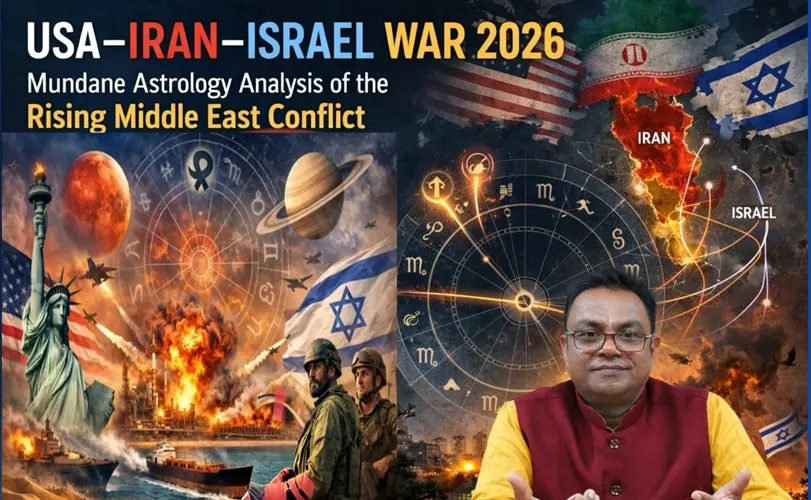
A Mundane Astrology Perspective: Timing, Not Fear
It is important to approach astrology with clarity and responsibility. Astrology does not create events—it reflects timing patterns.
In 2026, several strong planetary influences indicate a period of pressure, restructuring, and transformation.
Mars Influence – Acceleration of Conflict
Mars represents action, assertion, and military energy. When activated strongly:
- Decisions tend to be fast and aggressive
- Diplomatic processes weaken
- Conflicts escalate rapidly
This aligns with the speed and intensity of current developments.
Saturn Influence – Structural Pressure
Saturn governs systems, institutions, and authority structures. Its activation often correlates with:
- Pressure on existing global systems
- Shifts in leadership and governance
- Restructuring of alliances
Historically, such periods coincide with major geopolitical transitions.
Rahu Archetype – Unconventional Warfare
Rahu represents unpredictability and innovation. In modern geopolitical terms, this translates into:
- Drone and AI-assisted warfare
- Cyber operations and intelligence conflicts
- Psychological and narrative-driven warfare
This explains why the current conflict feels complex and non-linear. It is not a traditional war—it is a hybrid strategic conflict.
👉 For deeper personalized insights on global events and their impact, explore our Mundane Astrology consultation services:
https://ashokaacharya.com/
Ground Reality: Beyond Astrology
It is essential to remain grounded in reality.
This conflict is driven by:
- Energy security
- Regional dominance
- Strategic deterrence
- Political and military decision-making
Astrology simply reflects when these pressures reach a critical threshold.
Strategic Outlook: What Happens Next?
Short-Term (0–3 Months)
- Continued tactical strikes
- High military readiness
- Controlled escalation without full-scale global war
Medium-Term (3–12 Months)
- Increased diplomatic engagement through global mediators
- Economic pressure becoming a key factor
- Attempts at controlled de-escalation
Long-Term Perspective (2025–2030)
This conflict is part of a broader global restructuring phase where:
- Power is shifting from centralized dominance to multi-polar systems
- Economic and technological influence becomes more important than territorial control
- New alliances and global frameworks begin to emerge
👉 If global changes are affecting your career or financial decisions, a personalized astrology consultation can provide clarity and direction:
https://ashokaacharya.com/
The Deeper Question Most People Miss
The common question is:
“Who will win?”
But a more intelligent question is:
“What new global system will emerge after this conflict?”
Modern conflicts are no longer just about land or borders. They are about:
- Narrative control
- Economic influence
- Technological leadership
Final Insight
The USA–Iran–Israel conflict of 2026 represents more than a regional war. It is a signal of global transformation.
Old systems are weakening.
New systems are forming.
The outcome of this phase will shape geopolitical, economic, and strategic realities for the coming decade.
👉 Learn more about Ashok Aacharya’s approach and global experience in Vedic astrology and strategic guidance:
https://ashokaacharya.com/
About the Author
Ashok Aacharya is a globally recognized Spiritual Wellness Strategist, Vedic Astrologer, and Geopolitical Thinker with over 35 years of experience.
He has guided more than 500,000 clients worldwide, including business leaders, public figures, and international professionals. His approach combines modern strategic thinking with Vedic wisdom, focusing on logic, clarity, and practical transformation.
Website: https://ashokaacharya.com/
FAQs
Q1: Is the USA–Iran–Israel War 2026 leading to World War 3?
At present, it remains a regional conflict with global implications. While escalation risks exist, it has not reached the scale of a world war.
Q2: What does astrology indicate about global conflicts?
Astrology highlights timing cycles where pressure and transformation occur, especially through planetary influences like Mars and Saturn.
Q3: Why is 2026 considered significant?
It represents a transition period where global systems are undergoing restructuring, increasing the likelihood of instability and conflict.
Q4: What makes this conflict different?
This conflict involves hybrid warfare, including cyber operations, drone technology, and economic impact—making it more complex than traditional wars.
What is your perspective on this situation?
Do you see this as a temporary conflict or the beginning of a larger global shift?


