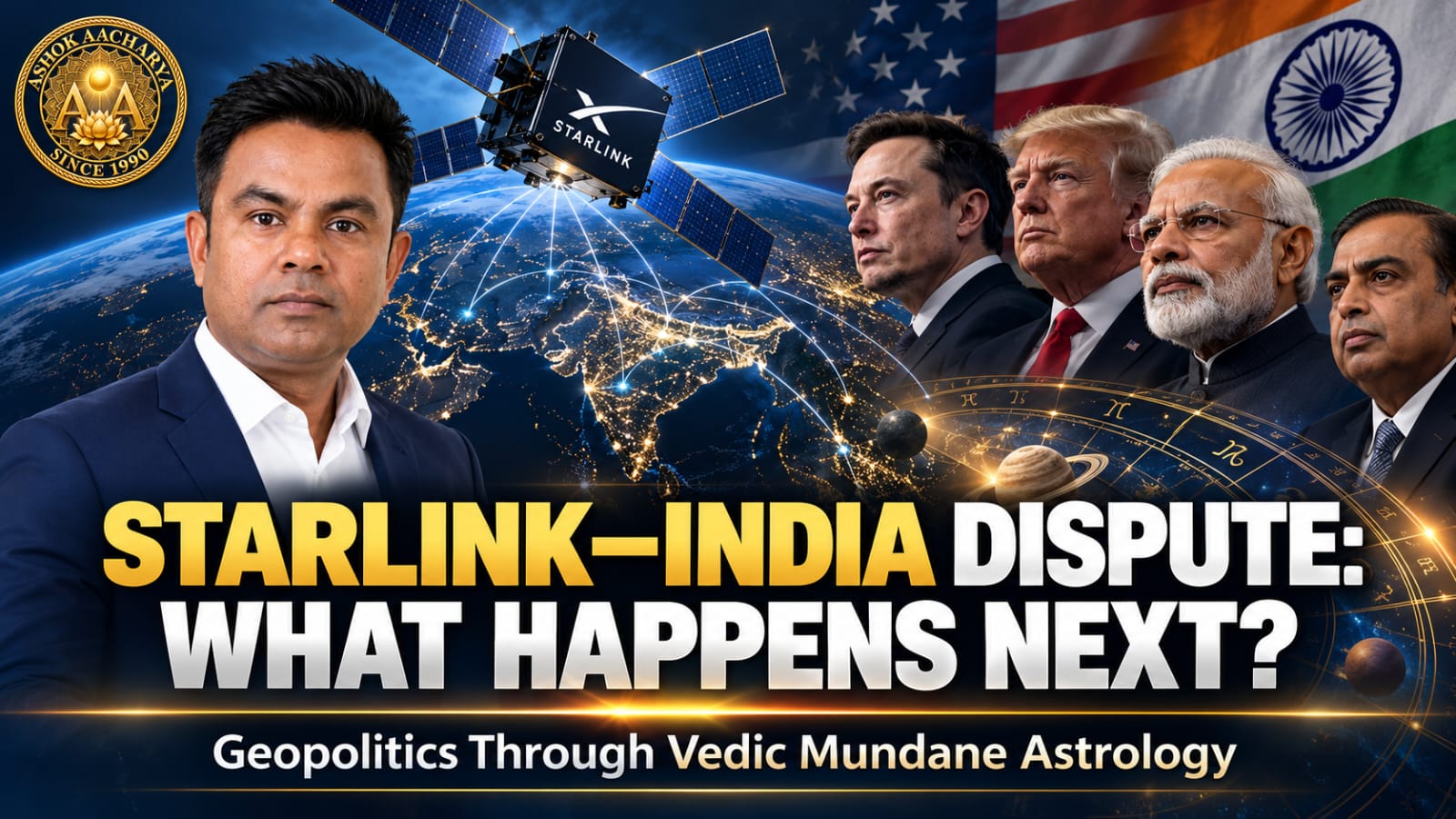
Starlink, Elon Musk and India: A Vedic Mundane Astrology Forecast
The real question is not simply whether Starlink will launch in India. It is who controls strategic connectivity, under what conditions, and who ultimately benefits.
Starlink vs. India: What Is Really at Stake?
Elon Musk wants Starlink, the satellite internet business of SpaceX, to enter India. The Indian government has granted the company a satellite communications license, but commercial service still requires security compliance and spectrum assignment.
The disagreement became public when Musk accused powerful business interests of obstructing Starlink’s entry and subsequently targeted Mukesh Ambani and his Reliance Jio business. He has also promised affordable pricing for Indian customers, without announcing a price.
India’s government has rejected allegations of discriminatory treatment, stating that Starlink, Jio Satellite Communications and Eutelsat OneWeb are at broadly the same regulatory stage. Security assessments remain underway.
The security question is substantial. Unlike conventional mobile networks, a satellite network operates across national boundaries. Indian authorities need confidence that applicable security requirements, lawful monitoring and data protections can be enforced, including during emergencies.
Starlink says it has prepared its Indian infrastructure to meet local requirements. The government must assess whether those commitments satisfy the conditions for commercial operation.
This is where the dispute becomes geopolitical: a global technology company wants access to a major market, while India must retain control over communications infrastructure operating within its jurisdiction.
Beyond the Public Argument: What Each Side Is Protecting
Elon Musk: Market Access, Scale and Competitive Pressure
India offers Starlink a substantial opportunity, but it is not an easy market to enter.
Indian consumers already benefit from exceptionally inexpensive mobile data. Starlink cannot assume that satellite technology alone will persuade customers to pay more. Its strongest opportunities may lie in remote locations, difficult terrain, business operations and other settings where conventional connectivity is limited.
Musk’s public messaging frames the dispute around competition and consumer choice. That is a powerful commercial argument, but it does not establish that Indian businesses have improperly blocked Starlink.
The underlying commercial test is straightforward: can Starlink establish market access, meet India’s requirements and offer a service customers consider worth the price?
Narendra Modi’s Government: Sovereignty Without Closing the Door
India has two strategic interests to protect.
It wants investment, advanced technology, greater digital access and opportunities for domestic businesses. It must also ensure that a foreign-controlled communications network can operate under Indian law.
There is a reputational risk on both sides of the decision. An opaque approval process can fuel suspicions of favoritism. Approval apparently granted under public pressure could raise questions about the consistency of India’s regulatory authority.
The strongest institutional response is neither automatic rejection nor automatic approval. It is a clear, enforceable set of requirements applied consistently to eligible operators.
This approach protects India’s sovereign decision-making while leaving room for legitimate technological competition.
Mukesh Ambani and India’s Telecom Industry: Competition Is Not Proof of Wrongdoing
Reliance Jio has a commercial interest in India’s telecommunications market and its own satellite ambitions. Other established operators also have interests in satellite connectivity.
The disagreement over spectrum allocation predates Musk’s latest accusations. Traditional telecom companies have raised concerns about competitive fairness, while satellite operators have argued for administrative spectrum allocation rather than auctions.
India ultimately adopted administrative allocation under its telecommunications law.
These competing commercial interests deserve scrutiny. But an incentive to resist competition is not proof that a company caused a regulatory delay. The fact that Jio and OneWeb have also awaited final approvals complicates the allegation that Starlink alone is being deliberately held back.
The distinction matters: commercial rivalry is a fact; deliberate regulatory obstruction remains an allegation.
Donald Trump and Washington: The Wider Geopolitical Dimension
Starlink is a US company, so its access to India intersects with broader questions of American technology exports and market access.
From Washington’s perspective, access for US technology businesses can become part of wider trade discussions. From New Delhi’s perspective, commercial opportunity does not remove the authority to set national security conditions.
There is no established public evidence that Trump has personally directed India’s Starlink licensing decision. The wider US–India relationship should therefore be considered context, not presented as proof of a presidential intervention.
A commercial dispute can carry diplomatic significance without becoming a formal confrontation between two governments.
What Indian Consumers Actually Need to Know
For Indian households, the important question is not which billionaire wins an argument on social media.
It is whether satellite internet will provide reliable connectivity where existing networks fall short, what it will cost, and what protections will apply to users and their data.
For remote communities, businesses and essential services, additional connectivity could be valuable. For customers already served by inexpensive mobile broadband, Starlink may offer a different service rather than a cheaper replacement.
An affordable-price promise becomes meaningful only when actual prices, service availability and performance are known.
What India’s National Horoscope Reveals
In Vedic Mundane Astrology, or Medini Jyotisha, national affairs are interpreted through the country’s adopted horoscope, relevant houses, planetary transits and traditional planetary significations.
Using India’s commonly adopted Independence chart, with Taurus rising, I read this dispute through the relationship between the tenth house of government and public authority, the sixth house of competition and disputes, the eleventh house of collective gains and networks, and the third house of communications.
The current astrological pattern brings three themes into focus.
Rahu and the tenth house: The symbolism connects disruptive technology and foreign commercial interests with public authority, national standing and the state’s response. The central question is how India accommodates innovation without surrendering regulatory control.
Saturn and institutional interests: Saturn’s traditional association with discipline, accountability and delay, considered alongside the eleventh house of networks and gains, supports an interpretation in which commercial opportunity must pass through institutional scrutiny.
Mercury, Venus and Jupiter: Their traditional associations with negotiation, commercial relationships, knowledge and communication bring the practical terms of market entry into focus. The promise of connectivity must be weighed against competition, enforceable conditions and public benefit.
This is not a claim that planets prove the motives of Musk, Modi or Ambani. It is the traditional astrological framework through which I interpret the observable dispute.
My Forecast: Regulatory Pressure Before a Clear Resolution
My Vedic Mundane Astrology assessment favors continued negotiation and regulatory scrutiny, with a conditional path toward commercial entry rather than an immediate, unconditional launch.
The next meaningful development is more likely to be defined by the handling of security requirements and spectrum assignment than by public statements alone.
Three indicators will determine whether this interpretation holds:
- Security: Can Starlink demonstrate that India’s applicable requirements can be enforced in practice?
- Authorization: Does the regulatory process advance to spectrum assignment and the remaining necessary approvals?
- Commercial value: Can Starlink establish pricing and service conditions that make sense for Indian customers?
If these conditions are satisfied, commercial entry becomes possible. If they remain unresolved, the public dispute may continue without an operational launch.
I would not treat a particular launch date as established by astrology. The forecast is conditional, and its practical direction must be reassessed as official decisions emerge.
The Larger Lesson for India and the World
India is not required to choose between national sovereignty and technological progress. Nor should sovereignty become a reason to shield any company from legitimate competition.
The durable outcome is one in which security requirements are enforceable, regulatory conditions are applied consistently, commercial claims can be tested, and consumers receive genuine value.
For the United States, the case highlights the realities of entering strategically important foreign markets. For India, it tests the ability to welcome global technology without compromising national authority.
My central forecast is a controlled, compliance-led route toward possible market entry—not a guaranteed launch and not evidence of permanent exclusion.
In the final analysis, Starlink’s commercial ambitions, India’s sovereign responsibilities and the interests of Indian consumers must all be considered. That is the geopolitical significance of this dispute, and the central theme of my Medini Jyotisha reading.
Frequently Asked Questions
1. What Is the Starlink–India Dispute About?
The Starlink–India dispute concerns commercial market entry, national security requirements, spectrum assignment and competition in satellite internet. Elon Musk has alleged that business interests are obstructing Starlink’s entry, while the Indian government maintains that all licensed operators must satisfy the applicable regulatory conditions. The allegations of deliberate obstruction remain unproven.
2. Has Starlink Been Approved in India? When Will It Launch?
Starlink has received an Indian satellite communications license, but this does not authorize immediate commercial operations. The remaining requirements include security compliance and spectrum assignment. A confirmed commercial launch date should not be assumed until the necessary approvals are complete.
3. Why Is Elon Musk’s Starlink Dispute Important for India and the United States?
The dispute highlights the relationship between international technology businesses, market access and national sovereignty. For India, the priorities include secure communications, consumer interests and fair competition. For the United States, the case illustrates the regulatory requirements American technology companies must meet when entering major international markets.
4. How Could Starlink Change India’s Internet and Satellite Communications Market?
Starlink could expand connectivity in remote, mountainous and underserved regions where conventional networks are difficult or expensive to deploy. Its commercial impact will depend on pricing, coverage, service quality, regulatory approval and competition with existing providers. Its potential benefits should therefore be evaluated against actual availability and consumer costs.
5. What Is Vedic Mundane Astrology, or Medini Jyotisha?
Vedic Mundane Astrology, traditionally known as Medini Jyotisha, is the branch of Vedic astrology concerned with nations, governments, economic conditions, international relations and major collective developments. Its traditional methods examine national horoscopes, planetary transits and relevant house significations to interpret geopolitical trends. These interpretations should be distinguished from independently verified facts and scientifically established predictions.
6. What Does Vedic Mundane Astrology Indicate About the Starlink–India Dispute?
The astrological interpretation presented by Ashok Aacharya emphasizes the relationship between foreign technology, national authority, commercial competition and regulatory oversight. The forecast favors continued scrutiny and a possible negotiated path toward commercial entry, conditional on compliance with India’s requirements. It does not establish a guaranteed launch date or determine the intentions of any individual or government.
7. Can Vedic Mundane Astrology Forecast Global Geopolitical Developments?
Vedic Mundane Astrology provides a traditional framework for interpreting national and international developments through planetary cycles and national-chart analysis. Responsible forecasting also requires examining documented events, institutional decisions and observable indicators. Astrological interpretations should remain conditional, transparent and open to reassessment as circumstances change.
8. How Does Ashok Aacharya Approach Geopolitical Forecasting Through Vedic Astrology?
Ashok Aacharya combines the traditional framework of Vedic Mundane Astrology with geopolitical context and strategic analysis to interpret developments affecting nations, governments, businesses and international relations. His approach distinguishes verified facts from astrological interpretation and conditional forecasts, emphasizing national interests, practical implications and observable developments rather than sensational claims or guaranteed outcomes.
About Ashok Aacharya
Ashok Aacharya is a Spiritual Wellness Strategist, Strategic Forecaster, Global Trends Analyst, Vedic Astrology & Vastu Shastra Researcher, Author & Speaker, and Advisor to Global Leaders Since 1990.
He bridges Vedic wisdom with contemporary strategic thinking to bring greater clarity to leadership, business, career, and important life decisions.
Ashok Aacharya’s media and public engagements include television appearances, expert interviews and commentary, talk shows, panel discussions, debates, podcasts, public lectures, keynote addresses, conference presentations, roundtables, articles, and digital programmes. His media presence includes Speaking Tree by The Times of India, NBT Astro by Navbharat Times, Zee News, News Nation, and Amar Ujala. His published media material also includes content distributed by ANI and published in Business Standard’s Press Releases section.