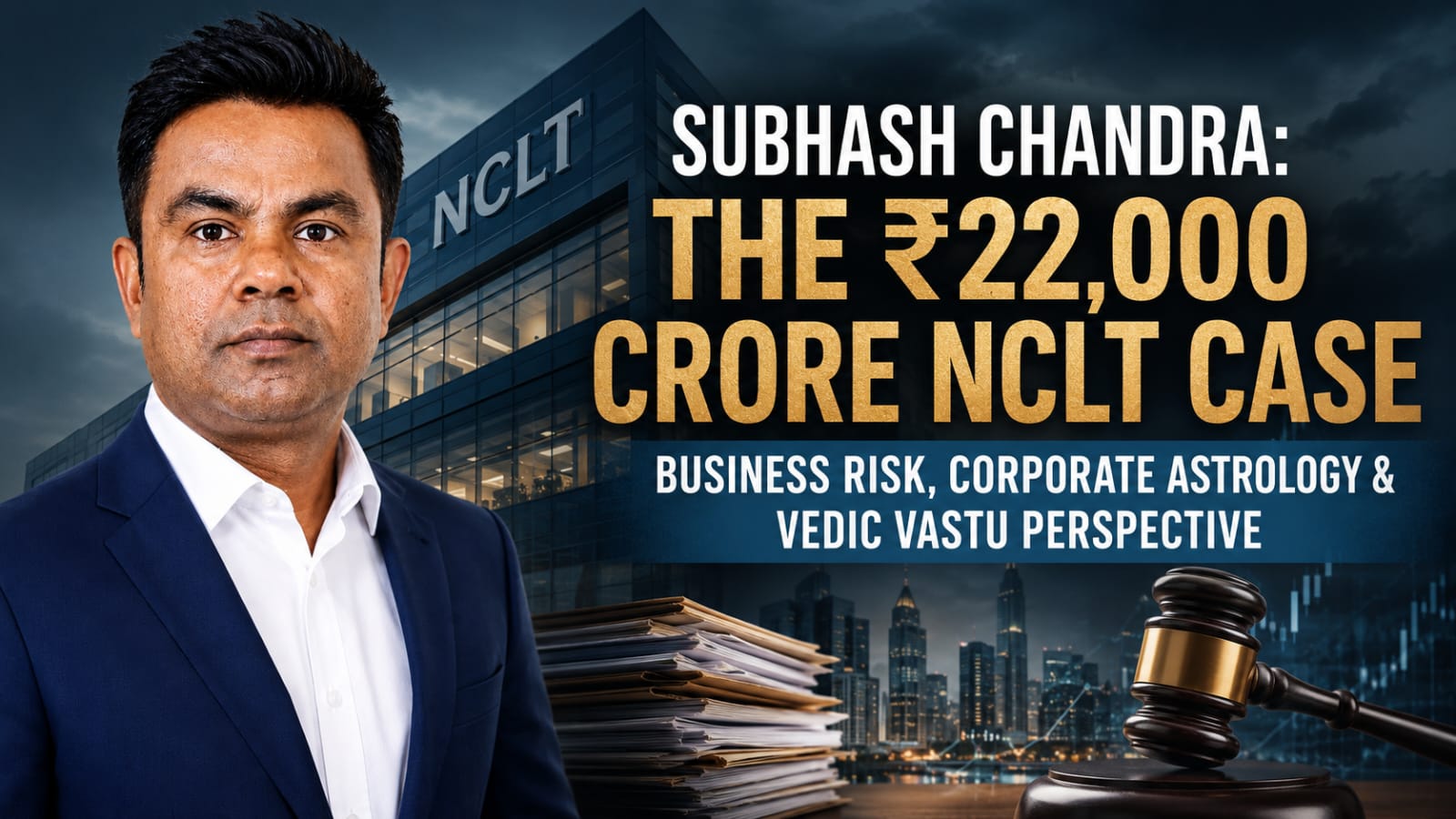
Subhash Chandra NCLT Case: ₹22,000 Crore Controversy, Business Risk & Vedic Insights
By Ashok Aacharya
Spiritual Wellness Strategist | Strategic Forecaster | Global Trends Analyst | Vedic Astrology Researcher | Author & Speaker | Since 1990
A ₹22,000-crore headline can make a complicated business and legal matter appear remarkably simple.
But the latest controversy surrounding Subhash Chandra, the NCLT, creditor recovery and his public allegations involving Mukesh Ambani and Reliance-linked media is about much more than a headline.
It raises important questions about personal guarantees, corporate borrowing, financial risk, reputation, leadership and the consequences of major business decisions.
The latest development is significant. On August 25, 2026, the National Company Law Tribunal (NCLT) approved a repayment plan in Subhash Chandra’s personal insolvency proceedings under which creditors are to receive ₹6.25 crore, with ₹25 lakh toward the insolvency process, against approximately ₹22,006.57 crore of admitted claims.
The plan received approximately 80.81% support from voting creditors, while several lenders opposed it. Canara Bank, Union Bank of India and LIC Housing Finance have announced plans to challenge the decision before the National Company Law Appellate Tribunal (NCLAT), while HDFC Bank has indicated that it is considering an appeal.
So, as of August 29, 2026, the matter is not finally settled.
Perspective & Context
This article is based on publicly available information and developments reported through August 29, 2026. The NCLT decision remains subject to the appellate process, and statements or allegations made by the parties are presented as their respective positions rather than as established facts.
My perspective combines business strategy, corporate risk, Vedic Astrology and Vedic Vastu as complementary frameworks for reflection and decision-making, alongside factual, legal and practical analysis.
The objective is simple: understand the facts clearly, examine the deeper patterns intelligently, and make better decisions.
What Does the ₹22,000 Crore Figure Actually Mean?
This is the first distinction that needs to be understood.
The approximately ₹22,006.57 crore figure represents admitted claims in Chandra’s personal insolvency proceedings. It should not simply be described as ₹22,000 crore that Subhash Chandra personally borrowed as an ordinary personal loan.
The proceedings relate to obligations connected with personal guarantees provided for corporate borrowings.
Chandra has also disputed the way the ₹22,000-crore figure has been presented publicly, arguing that it can create the impression that he personally borrowed the entire amount.
That is his stated position and should be understood as such.
This distinction matters because a financial number without its legal context can easily produce a misleading impression.
In serious business analysis, the number is only the beginning. The structure behind the number matters just as much.
Why Are the Lenders Challenging the Repayment Plan?
The proposed recovery is extremely small compared with the admitted claims.
Several lenders therefore opposed the plan and are seeking appellate review.
Canara Bank, Union Bank of India and LIC Housing Finance have said they will challenge the NCLT decision before the NCLAT. HDFC Bank has also indicated that it is considering an appeal.
The final outcome should therefore not be predicted as a certainty.
The NCLT has approved the plan, but the appellate process remains an important next stage.
Where Does Mukesh Ambani Come Into the Story?
This is another area where headlines can create confusion.
Mukesh Ambani did not initiate the personal insolvency proceedings against Subhash Chandra.
The proceedings originated with Indiabulls Housing Finance.
Mukesh Ambani has entered the current public discussion because Chandra has accused Reliance-linked media entities of presenting what he described as “wrong propaganda” against him and his group.
Reliance has rejected those allegations as baseless and has stated that its media entities have never been used to attack anyone.
These are competing positions.
They should not be presented as established facts.
The earlier corporate history involving Zee, Invesco and Reliance is relevant background, but it should also be kept separate from the legal question currently before the insolvency process.
A public controversy and a legal proceeding are not necessarily the same thing.
The Bigger Business Lesson: Personal Guarantees Are Real Risk
For me, this is the most important lesson in the entire case.
Corporate borrowing can be an essential part of business growth.
Debt can finance expansion, acquisitions, infrastructure and new opportunities.
But when a promoter provides a personal guarantee, corporate risk can become personal financial exposure.
Before signing such a guarantee, an entrepreneur should ask:
- What exactly am I guaranteeing?
- What is the maximum exposure?
- How long does the obligation remain?
- Under what circumstances can it be invoked?
- What happens if the business underperforms?
- Can my personal financial position absorb the worst realistic outcome?
These questions are not signs of fear.
They are signs of responsible leadership.
Ambition should always be accompanied by an understanding of downside risk.
My Corporate Astrology Perspective
Corporate Astrology should never be used to claim that a planet caused a company’s debt, insolvency or legal dispute.
That is not how I approach Vedic Astrology.
I see Corporate Astrology as a traditional interpretive framework that can complement business strategy, financial analysis, market intelligence and leadership judgment.
One recurring principle is the relationship between expansion and structural strength.
A business can grow rapidly while its governance, liquidity, management systems or risk controls fail to develop at the same pace.
This is where the traditional symbolism of Saturn offers a useful perspective.
In Vedic Astrology, Saturn is traditionally associated with discipline, responsibility, structure, accountability, endurance and consequences.
I do not interpret this as evidence that Saturn caused the events discussed in this article.
Rather, it offers a powerful business metaphor:
Growth creates opportunity. Structure determines whether growth can withstand pressure.
That principle applies to businesses everywhere.
Vedic Astrology and Better Corporate Decisions
When I apply Vedic Astrology to business, I do not begin with:
“Which planet will make the company successful?”
I begin with practical questions.
Is the organization ready for the scale it is pursuing?
Is the timing appropriate for a major commitment?
Is leadership taking more risk than the existing structure can support?
Are decisions being made from strategic clarity or from urgency?
Can the organization absorb delays and unexpected developments?
Only after understanding these practical realities does the astrological perspective become meaningful.
Financial analysis establishes the numbers.
Legal analysis establishes the obligations.
Business strategy evaluates the choices.
Vedic Astrology provides an additional traditional perspective on timing, cycles and responsibility.
It should complement—not replace—sound decision-making.
Vedic Vastu and the Corporate Environment
Vedic Vastu has a different but complementary role.
I would never claim that an office direction caused a company’s financial difficulties.
Vedic Vastu is more appropriately considered as a traditional framework for understanding the relationship between space, organizational functions and human behavior.
A corporation is not only a balance sheet.
It is an environment in which people think, communicate, negotiate and make decisions.
Leadership spaces, departmental relationships, movement, concentration and workplace organization can therefore be examined as part of a broader approach to organizational effectiveness.
For me, the practical value of Vedic Vastu is not:
“Change one direction and the business will become successful.”
It is:
“Can the physical environment better support the people and functions operating within it?”
That is a far more responsible way to apply Vastu in modern corporate life.
The Human Side of Business Risk
Behind every large financial dispute are people.
Promoters.
Employees.
Lenders.
Investors.
Families.
Professional advisers.
The public often sees only the number.
But business leaders experience the consequences personally.
This is why I believe entrepreneurs should periodically step back from their own success and ask a difficult question:
If circumstances change, is the structure I have created still capable of carrying the weight?
Past success does not guarantee future success.
A strategy that worked under one market environment may become inappropriate under another.
The ability to reassess assumptions is therefore one of the most important qualities of leadership.
What Entrepreneurs Can Learn From This Case
The lessons extend well beyond India.
1. Treat every personal guarantee seriously
A guarantee is not merely paperwork.
2. Stress-test the downside
Do not model only the expected outcome.
3. Match leverage with resilience
Debt can accelerate growth, but it can also accelerate financial stress.
4. Build governance that can challenge the founder
A strong leadership team should be capable of questioning major assumptions.
5. Protect reputation
Reputation is a form of strategic capital and can take years to build.
6. Separate fact from allegation
Especially when disputes involve prominent individuals or corporations.
7. Reassess decisions as circumstances change
Strategic flexibility is not weakness.
It is strength.
What Happens Next?
As of August 29, 2026, the immediate focus is the proposed appellate challenge to the NCLT-approved repayment plan.
The NCLAT process may provide further clarity on the lenders’ objections and the future of the repayment arrangement.
The public debate surrounding the ₹22,006.57 crore figure and the allegations involving Reliance-linked media may also continue.
For now, the responsible approach is to distinguish between what is documented, what is reported, what is alleged and what remains to be determined.
That discipline is valuable not only in this case but in every major business decision.
My Final Perspective
I do not see the most useful lesson here as simply Subhash Chandra versus Mukesh Ambani.
Nor is it simply ₹22,000 crore versus ₹6.25 crore.
The deeper lesson is about growth, leverage, personal guarantees, corporate structure, reputation and judgment.
For entrepreneurs, the message is straightforward:
Do not measure a major business decision only by its potential reward. Measure it by the consequences you are prepared to carry if the assumptions fail.
Vedic Astrology can encourage us to think about cycles, responsibility and structural strength.
Vedic Vastu can encourage us to think about the relationship between physical environment and organizational functioning.
Business strategy keeps both grounded in practical reality.
Used responsibly, these perspectives do not replace evidence.
They help us ask better questions.
And better questions lead to better decisions.
Ancient Wisdom. Modern Strategy. Better Decisions.
Frequently Asked Questions
What is the Subhash Chandra NCLT case?
It is a personal insolvency proceeding involving Subhash Chandra in connection with obligations arising from personal guarantees linked to corporate borrowings. The NCLT approved a repayment plan providing ₹6.25 crore to creditors against approximately ₹22,006.57 crore of admitted claims.
Did Subhash Chandra personally borrow ₹22,000 crore?
The ₹22,006.57 crore figure represents admitted claims in the personal insolvency proceedings. It should not simply be characterized as ₹22,000 crore of ordinary personal borrowing by Chandra.
Is Mukesh Ambani responsible for the NCLT case?
The insolvency proceedings were initiated by Indiabulls Housing Finance, not Mukesh Ambani. Chandra has separately made allegations concerning Reliance-linked media coverage, which Reliance has rejected.
Why are lenders challenging the NCLT repayment plan?
Several lenders have objected to the very low proposed recovery and other aspects of the plan. Some have announced challenges before the NCLAT.
Can Vedic Astrology explain a corporate financial crisis?
Vedic Astrology should not be presented as proof that a planet caused a financial or legal event. It can be used as a traditional interpretive framework for examining timing, cycles, responsibility and strategic decision-making alongside conventional business analysis.
How can Vedic Vastu be relevant to corporations?
Vedic Vastu can provide a traditional framework for considering the relationship between physical space, organizational functions and human behavior. It should complement, rather than replace, sound management, governance and business strategy.
About Ashok Aacharya
Ashok Aacharya — Spiritual Wellness Strategist | Strategic Forecaster & Global Trends Analyst | Vedic Astrology Researcher | Author & Speaker | Advisor to Global Leaders Since 1990
Since 1990, Ashok Aacharya has advised business leaders, entrepreneurs, professionals, public figures, and high-net-worth individuals internationally. His work combines strategic analysis, global trends, human behavior, and Vedic wisdom, with an emphasis on critical thinking and responsible interpretation. His insights have been featured in The Times of India, Business Standard, ANI, Zee News, Speaking Tree, Navbharat Times, Amar Ujala, News Nation, and other leading media.
Ancient Wisdom. Modern Strategy. Better Decisions.