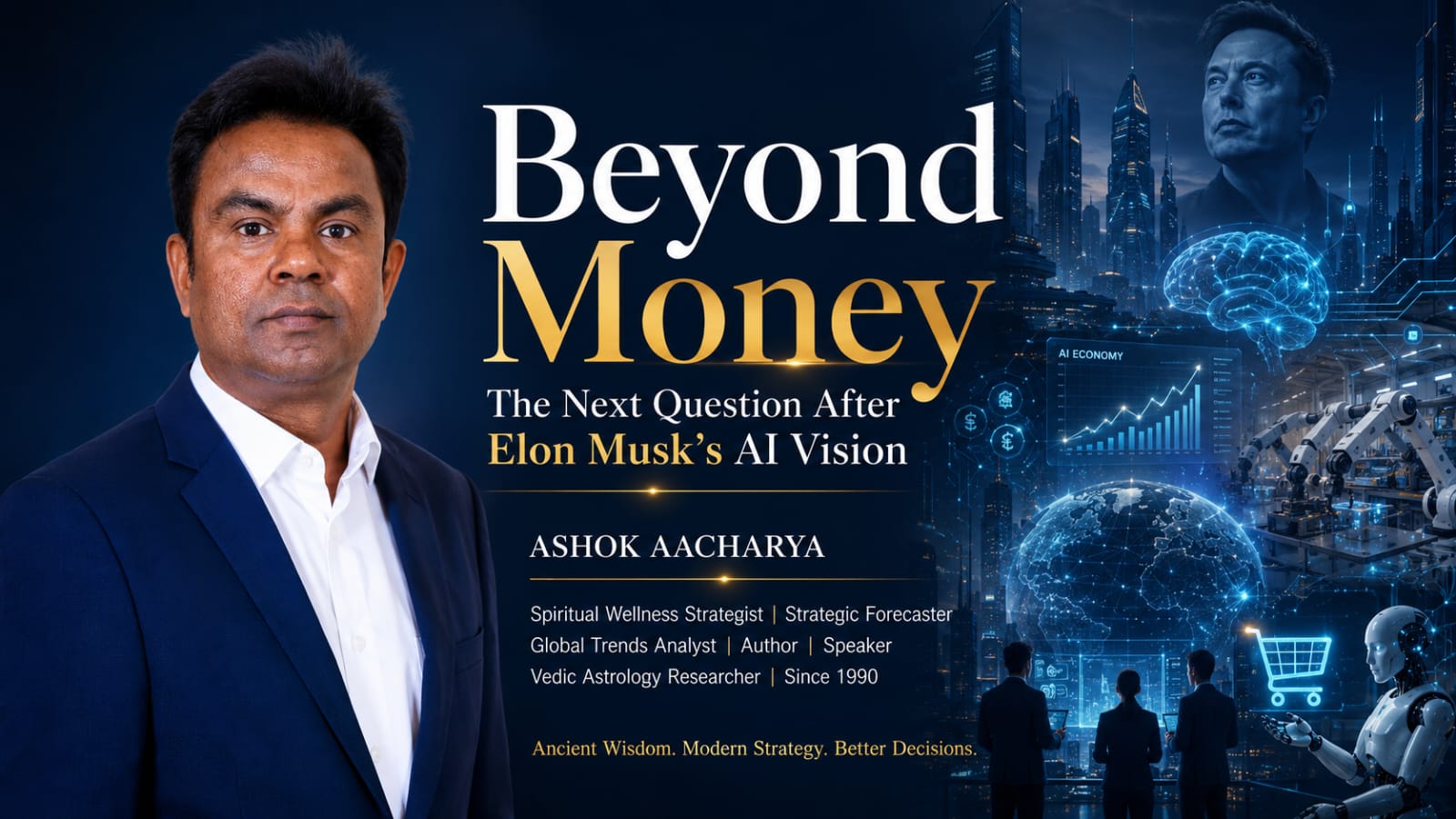
Beyond Money: What AI Means for Human Value, Work and Wealth
AI and human value are becoming inseparable questions as artificial intelligence moves from an experimental technology into everyday business, professional and economic life. The bigger question is no longer whether AI can perform human tasks; it is whether society will redefine human value around what machines cannot easily replace.
For executives, founders and professionals, this distinction matters. The next competitive advantage may not belong simply to the person who knows how to use AI, but to the person who knows what should be done, why it matters, and what consequences follow from doing it.
The World Economic Forum’s Future of Jobs Report 2025 projects significant job creation alongside job displacement by 2030, pointing toward a major restructuring of work rather than a simple story of jobs disappearing.
The strategic issue, therefore, is not simply employment. It is the changing relationship between human judgment, machine capability, productivity and wealth creation.
AI Is Changing the Meaning of Human Value
AI is increasingly capable of performing activities that were previously considered valuable professional skills: summarizing information, analyzing patterns, generating content, writing code, preparing reports and supporting decisions.
But performing a task and creating meaningful value are not the same thing.
Human value increasingly comes from the ability to:
- Define the right problem.
- Understand context and consequences.
- Exercise judgment under uncertainty.
- Build trust and relationships.
- Create original strategic direction.
- Take responsibility for decisions.
- Connect information across seemingly unrelated domains.
AI may reduce the value of routine execution while increasing the importance of higher-order human capabilities.
That does not mean every human skill automatically becomes more valuable. Skills that AI can reproduce cheaply may experience economic pressure. Human capabilities that provide context, accountability, trust and direction may become more strategically significant.
The New Division of Work Between Humans and AI
The future of work is unlikely to be a simple competition between humans and machines. A more useful model is human-machine collaboration, where AI increasingly handles execution while humans concentrate on framing, judgment and responsibility.
Consider a simple business decision.
AI may be able to analyze market data, compare competitors, identify patterns and generate strategic options. But an executive still has to decide:
Which opportunity fits the organization’s purpose, risk tolerance, culture and long-term position?
That final layer is not merely information processing. It involves judgment.
The same principle applies to leadership, investing, entrepreneurship and professional careers.
The emerging advantage may therefore belong to people who can operate at two levels simultaneously:
- Use AI effectively.
- Think independently of AI.
Dependence on AI without independent judgment creates a different problem: faster decisions that may still be wrong.
From Employment to Economic Value
The deeper transformation may be economic rather than technological.
Historically, income has often been connected to labor, expertise, scarcity and ownership. AI challenges this relationship by making certain forms of expertise easier and cheaper to reproduce.
When information becomes abundant, attention, judgment, trust, creativity and strategic direction become comparatively more important.
This could create both opportunities and inequality.
Organizations that successfully combine AI with skilled employees may achieve higher productivity. Workers who continuously develop relevant capabilities may become more valuable. At the same time, people whose work consists primarily of repetitive, easily automated tasks may face greater pressure.
The important question for business leaders is:
Are you building a workforce that merely uses AI, or a workforce that becomes more capable because of AI?
That distinction may determine whether AI becomes a cost-cutting tool or a genuine source of organizational advantage.
A Human Value Framework for the AI Era
I use a simple framework to examine human value during periods of technological disruption:
The VALUE Framework
V — Vision
Can you identify where the organization or individual should go before technology determines the direction?
A — Adaptability
Can you learn, unlearn and reposition your skills as technology changes?
L — Leadership
Can you influence people, create trust and take responsibility when the answer is uncertain?
U — Understanding
Can you interpret information within its social, cultural, financial and human context?
E — Ethics
Can you distinguish what can be done from what should be done?
This framework matters because technological capability alone does not establish wisdom.
AI can generate options. Humans still need to determine which options deserve pursuit.
From a strategic forecasting perspective, the winners of major technological transitions are rarely those who predict one perfect future. They are the people and organizations capable of preparing for several plausible futures while retaining the ability to adapt.
What Leaders Should Do Now
Leaders should stop treating AI adoption as only a technology project. It is increasingly a human-capability and organizational-design project.
Three priorities deserve attention:
- Redesign work around outcomes rather than tasks. Identify which activities should be automated, augmented or retained primarily for human judgment.
- Invest in human capabilities. Communication, creativity, critical thinking, leadership, problem-solving and ethical judgment become more important as AI handles more execution.
- Build AI literacy across the organization. Employees do not all need to become AI engineers. They do need enough understanding to use AI responsibly, evaluate outputs and recognize limitations.
For individuals, the message is equally practical: do not compete with AI on tasks where AI is structurally better positioned. Develop the capabilities that allow you to direct, challenge, interpret and apply AI.
Practical Executive Takeaways
- Do not ask only, “What jobs will AI replace?” Ask which tasks will change and which new forms of value will emerge.
- Separate execution from judgment. Automate repetitive execution while protecting human responsibility for consequential decisions.
- Develop hybrid capability. Combine technological fluency with communication, creativity, strategic thinking and domain expertise.
- Measure productivity carefully. Faster output is not necessarily better performance if judgment, trust or quality deteriorate.
- Think beyond income. In an AI-driven economy, human value may increasingly depend on purpose, relationships, judgment, ownership and the ability to create meaningful outcomes.
FAQ
Q: Will AI make human workers less valuable?
A: AI may reduce the economic value of some repetitive or easily automated tasks, but that does not mean human workers as a whole become less valuable. Human judgment, creativity, leadership, communication, contextual understanding and accountability can remain important, particularly where decisions involve uncertainty, relationships, ethics and long-term consequences.
Q: What human skills will matter most in the AI era?
A: Human skills likely to remain strategically important include critical thinking, creativity, communication, leadership, adaptability, problem-solving and ethical judgment. The most valuable professionals may increasingly combine these capabilities with strong AI literacy rather than treating technology and human expertise as separate domains.
Q: Will AI create more jobs than it destroys?
A: The outcome will vary by industry, country, occupation and how organizations adopt AI. The World Economic Forum’s 2025 employer survey projected significant job creation alongside displacement by 2030, illustrating that AI-driven transformation is better understood as restructuring than as a simple increase or decrease in employment.
Q: How should business leaders prepare for AI?
A: Business leaders should evaluate which tasks can be automated, which should be augmented and which require human judgment. They should also invest in AI literacy, reskilling, leadership capability and responsible governance. The objective should be to increase organizational capability, not simply reduce headcount or accelerate output.
About Ashok Aacharya
Ashok Aacharya is a Spiritual Wellness Strategist, Strategic Forecaster, Global Trends Analyst, Author, Speaker, and Vedic Astrology Researcher. Since 1990, he has advised corporate leaders, entrepreneurs, and high-net-worth individuals worldwide — integrating Vedic Astrology, Vastu Shastra, Spirituality and Numerology with business strategy and behavioral insight. Guided by the philosophy Ancient Wisdom. Modern Strategy. Better Decisions, his work favors critical thinking over superstition. Featured in The Times of India, Speaking Tree, Nav Bharat Times, NBT ASTRO, Business Standard, Zee News, News Nation, and Amar Ujala an more
Explore Further
If you’re planning a new office layout or reassessing an existing one, personalized guidance can help translate these principles into a plan suited to your specific space, team, and business goals.
Website: https://ashokaacharya.com/ WhatsApp: +91-9871198709